A Complete Guide To Korean Names: Structure, Meaning & Modern Trends
Growing up around friends from South and North Korea, I became curious about how Korean names quietly carry such profound cultural significance, especially their unique three-syllable structure, which people worldwide often notice when they first learn about them.
I remember being surprised to discover that a family name like 성 or a given name like 이름 (and even forms such as (이름) and (성)) can follow patterns which feel simple on the surface yet hold historical layers far more meaningful than I expected. A helpful tool can even analyze these naming about male and female to reveal their deeper cultural origins.
Korean Name Generator
Select gender and generate authentic Korean names
Sometimes the story behind a single name felt like one or even two lifetimes of heritage. Many of these names are derived from Hanja, which gives them specific meanings, while others are purely Korean. As I explored K-pop, K-dramas, and a massive list of 200+ examples, I found myself looking for a style that fit a fictional character.
I was writing—because whether you want a name for yourself or you’re just trying to learn the origins behind their sound, this subtle system becomes a personal guide. But things get even more interesting when you notice how characters in the script influence meanings, since they depend on the symbols used.
The exact sense can shift entirely. Note that here, these small choices matter because many options are listed, and those tiny variations become the reason people see other layers in what appears simple.
And honestly, with the rise of global interest, people yourself included, maybe may not realize how also much richness exists in what seems like just a name, especially when the language includes forms such as 하나, which I first heard from a friend teaching me numbers in Korea; it felt like discovering a secret doorway on a culture that had always been right next to me.
Hidden Stories Behind Korean Family Names
When I first started studying Korean history, I didn’t expect that the stories behind common last names like Kim, Lee, and Park would collectively account for such a significant portion of the population, yet each surname carries a feeling of quiet poetry.
I remember learning how meanings like gold, plum tree, or gourd shaped my understanding of how family identity becomes a fundamental part of cultural heritage, especially when exploring how prevalent surnames such as Choi, Jung/Jeong, Kang, Cho/Jo, and Yoon and even Japanese family name include branches of history which tie people together as these traditions pass through generations.
Even now, I still find moments where some details surprise me—how diverse symbols become markers for clans, how other interpretations reveal deeper meanings, and how such roots are woven into personal narratives; and it always brings me back to here, thinking about the layers of the most familiar names that quietly hold entire lifetimes within them.
| Korean Family Name | Hangul | Meaning |
|---|---|---|
| Kim | 김 | Metal, gold, or iron |
| Lee | 이 | Plum tree |
| Park / Bak | 박 | Gourd |
| Gwan | 관 | Tube or pipe |
| Jeong | 정 | Upright, proper |
| Yang | 양 | Willow or positive / sun |
| An | 안 | Peace, safe |
| Jin | 진 | Treasure, precious, or truth |
| Yoo | 유 | Willow or abundance |
| Han | 한 | Korea |
| Nam | 남 | South |
| Cho / Jo | 조 | Ancestor or assist |
| Yun / Yoon | 윤 | Govern, rule |
| Bae | 배 | Long and flowing |
| Ma | 마 | Horse |
| Seo | 서 | West or calm |
| Shin | 신 | Spirit, belief, or new |
| Kwon | 권 | Power, authority |
| Hwang | 황 | Yellow, emperor |
| Im / Lim | 임 | Forest |
Why Korean Names Continue to Inspire the World
From K-dramas to K-pop, the demand for knowledge about Korean given names, Korean first names, and Korean last names and meanings keeps growing. Their beautiful structure, poetic meanings, and cultural depth make Korean names admired across the globe.
Whether you prefer cute Korean names, pretty Korean names, or long-respected common Korean names, Korean naming traditions offer an incredible mix of elegance and history.
Origins of Korean Last Names
When I first explored how Korean identity is shaped through naming traditions, I was struck by how surnames connect people to the past, especially through Hanja and the Chinese characters that often have specific meanings, giving each name a quiet story of its own; in conversations with friends, I learned how a single surname like Kim can link countless families who may share the same spelling yet belong to entirely different clans and lineages, each branch carrying its own history and pieces of family heritage.
These structures feel so deeply rooted in the culture, and I’ve always admired how many people instinctively know where they come from simply by knowing which lineage they are connected to, a tradition that grows even richer while names shift across time and regions, forming patterns that remain meaningful no matter how the world around them changes with the generations.
Korean First Names and Meanings
Korean first names often blend beauty, character, and intention, with each name carrying its own meaning shaped by culture, sound, and family hopes.
| Korean First Name | Hangul | Meaning | Gender |
|---|---|---|---|
| Ara | 아라 | Beauty, elegance | Female |
| Mina | 미나 | Bright, beautiful | Female |
| Jisoo | 지수 | Wisdom and excellence | Unisex |
| Hana | 하나 | One, flower | Female |
| Nari | 나리 | Lily | Female |
| Harin | 하린 | Enlightened, precious | Female |
| Sora | 소라 | Conch shell, sky | Female |
| Yuri | 유리 | Glass, crystal | Female |
| Sena | 세나 | World + elegance | Female |
| Hyejin | 혜진 | Wisdom + truth | Female |
| Taeyang | 태양 | Sun | Male |
| Minjun | 민준 | Clever, talented | Male |
| Jihun | 지훈 | Wisdom + rank | Male |
| Seojun | 서준 | Auspicious, talented | Male |
| Hyunwoo | 현우 | Wise + guardian | Male |
| Jaemin | 재민 | Wealth + cleverness | Male |
| Donghyun | 동현 | East + wise | Male |
| Youngho | 영호 | Heroic, great | Male |
| Woobin | 우빈 | Shining, refined | Male |
| Gyuwon | 규원 | Standard + origin | Unisex |
Common Korean Male and Female Names
When I think about how names shift over time in Korea, I always notice how they follow certain trends that feel shaped not only by traditional values but also by cultural factors connected to everyday life; sometimes it’s the influence of famous individuals.
The actors, athletes, K-pop stars, and other celebrities who spark a wave of interest, especially when a single name gains extra attention simply due to how widely it appears across media. In my own research, some of the most popular choices came from recent years, and here’s the part I enjoy.
You can literally look at these patterns and see how the language responds to culture, how certain names are influenced by admired figures, including those tied to music or film, and how a name’s rise says something about the moment and the people choosing it—a quiet but meaningful reflection of the times in which they were born.
Common Korean Male Names
| Name | Hangul | Meaning |
|---|---|---|
| Minjun | 민준 | Clever, talented |
| Seojun | 서준 | Auspicious, gifted |
| Jiho | 지호 | Wisdom + greatness |
| Hajun | 하준 | Great, talented |
| Jisoo | 지수 | Wisdom + excellence |
| Hyunwoo | 현우 | Wise + protector |
| Taeyang | 태양 | Sun |
| Donghyun | 동현 | East + wise |
| Jimin | 지민 | Smart, gentle |
| Jaehyun | 재현 | Talent + virtue |
| Sunwoo | 선우 | Good + divine |
| Jinhyuk | 진혁 | Truth + energy |
| Wonwoo | 원우 | Original + helper |
| Mingyu | 민규 | Clever + standard |
| Seunghyun | 승현 | Rising + worthy |
| Kyungsoo | 경수 | Respect + water |
| Hojun | 호준 | Strong + talented |
| Jaemin | 재민 | Wealth + clever |
| Youngho | 영호 | Heroic, brave |
| Woobin | 우빈 | Shining, refined |
Uncommon and Unique Korean Male Names
Here are some Korean male names that stand out for their rarity and meaningful origins, perfect for anyone looking for something special and less commonly heard. These names offer a fresh blend of tradition and individuality while still carrying the poetic depth found in Korean naming culture.
| Name | Hangul | Meaning |
|---|---|---|
| Sihun | 시훈 | Bright, excellent |
| Raon | 라온 | Joyful, happy |
| Jahan | 자한 | Kind, compassionate |
| Yul | 율 | Rhythm, law |
| Riwon | 리원 | Beautiful origin |
| Haneul | 하늘 | Sky, heaven |
| Geon | 건 | Strong, firm |
| Daon | 다온 | All good things |
| Areum | 아름 | Beauty |
| Yejo | 예조 | Ritual, harmony |
| Haru | 하루 | Day, sunlight |
| Juwon | 주원 | Precious, primary |
| Rian | 리안 | Graceful, gentle |
| Sihyuk | 시혁 | Vision + reform |
| Yuwon | 유원 | Gentle origin |
| Daehan | 대한 | Great Korea |
| Eunwoo | 은우 | Silver + divine intervention |
| Seobin | 서빈 | Upright + shining |
| Haon | 하온 | Warm, kind-hearted |
| Woojin | 우진 | Strength + treasure |
Korean Male Names with Good Meanings
| Name | Meaning |
|---|---|
| Haneul | Sky, heaven |
| Minjun | Clever, talented |
| Seojun | Auspicious, gifted |
| Hyunwoo | Wise, protective |
| Jisoo | Wisdom and excellence |
| Jaemin | Wealth and cleverness |
| Taeyang | Sun, brightness |
| Sunwoo | Good and divine |
| Dohyun | Wise and virtuous |
| Woojin | Strength and treasure |
10 Most Popular Korean Male Names
| Name | Meaning |
|---|---|
| Minjun | Clever, talented |
| Seojun | Auspicious, gifted |
| Haon | Warm, kind-hearted |
| Yejun | Talented, artistic |
| Jiho | Wisdom + greatness |
| Hajun | Great, talented |
| Dohyun | Wise + virtuous |
| Siwoo | Protector, guardian |
| Jisoo | Wisdom + excellence |
| Hyunwoo | Wise + protector |
10 Most Popular Korean Female Names
| Name | Meaning |
|---|---|
| Seoah | Auspicious, graceful |
| Minseo | Clever, bright |
| Yejin | Beautiful + precious |
| Jiwon | Wisdom + origin |
| Hana | One, flower |
| Sua | Excellence + beauty |
| Harin | Precious, clear |
| Ara | Beauty, elegance |
| Nayeon | Graceful, gentle |
| Yeonwoo | Beautiful harmony |
Trending Korean Names (2025)
According to recent statistics, the most popular baby names include:
Korean Boy Names
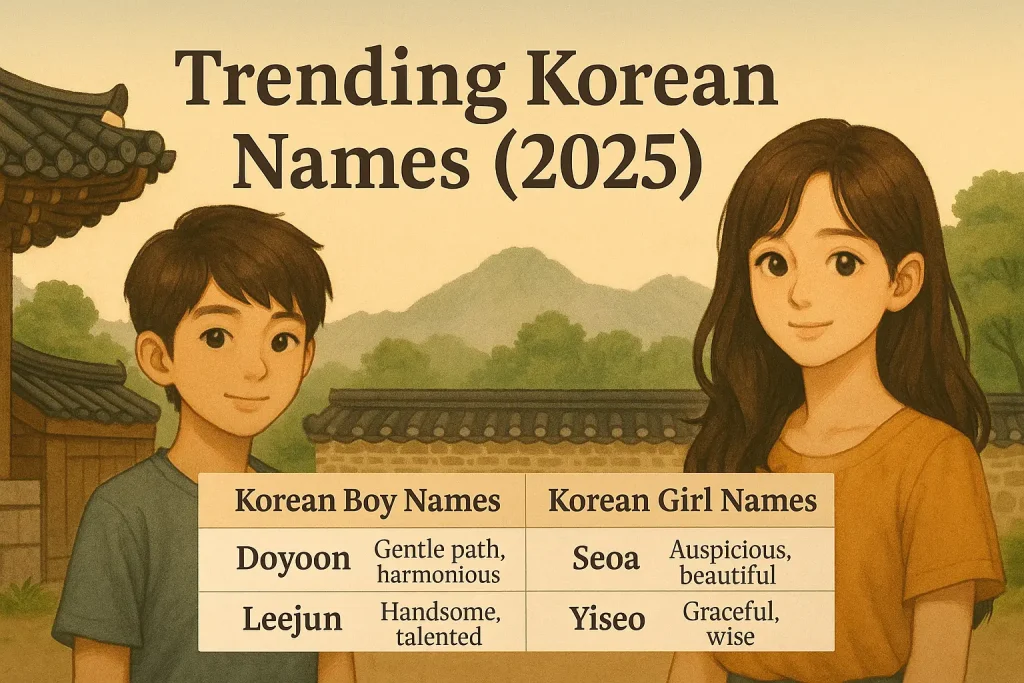
Here are some of the cutest Korean Boy names trending in 2025,
| Name | Meaning |
|---|---|
| Doyoon | Gentle path, harmonious |
| Leejun | Handsome, talented |
| Hajun | Great, calm strength |
| Taeo | Big, noble |
| Siwoo | Protector, guardian |
| Dohyun | Wise, virtuous |
| Eunwoo | Graceful, divine |
| Seojun | Auspicious, gifted |
| Jiho | Wisdom + greatness |
| Minjun | Clever, talented |
Koern Gil Name
Here are some of the cutest Korean girl names trending in 2025,
| Name | Meaning |
|---|---|
| Seoa | Auspicious, beautiful |
| Yiseo | Graceful, wise |
| Jian | Calm, steady |
| Seoyoon | Elegant, harmonious |
| Harin | Precious, clear |
| Arin | Pure and lovely |
| Jiyoo | Wisdom, freedom |
| Hayoon | Bright, hopeful |
| Ayoon | Gentle, modern |
| Jiwoo | Purpose, support |
Choosing the Right Korean Name
When I picked my first Korean name, I realised how much meaning, value, and hope shape it. Even one sound like Min(민) carries clever, gentle, or quick meanings in Hanja (한자) and Chinese characters. Whether you choose pure Korean words like Duri (두리) or Bitgaram (빛가람), each option brings a soft poetic resonance that can reflect your personality.
For non-native speakers, pronunciation can feel tricky, so I always test names by actually calling them aloud. Names like Joon (준), Hyunwoo (현우), Haon (하온) or Yuna (유나) shift in tone from traditional to trendy or modern. Nature names such as Haesol (해솔)—“sun + pine tree”—and Garam (가람) meaning river sound both creative and elegant.
Some families use the shared syllable 돌림자, linking siblings and cousins across the generations. I loved how Kim Junsu (김준수) and Kim Junho (김준호) share 준, creating a strong sense of heritage and family connection. Whether a Sino-Korean name (한자 이름) or 순우리말 이름, these traditions feel both formal and authentic.
Talking with a native speaker helped me avoid unwanted associations with celebrities or fictional characters after a simple search. They pointed out whether a name sounded natural, friendly, or truly respectful when paired with a surname like Kim Minho or Park Seojun. Even how you practice introducing the name can shape its flow.
In the end, you must decide whether you prefer Sino-Korean words, trendy modern styles like Yul (율) or Yeonwoo (연우), or the cute, creative, poetic feel of nature names. Whatever you choose, a name should feel right the moment someone calls it—simple, warm, and unmistakably yours.
Understanding Korean Names (Structure and Meaning)
When I first noticed how a Korean name appears almost everywhere, from a K-pop star to a K-drama character, a Korean movie role, or even a Korean athlete realised how familiar these popular Korean individuals already felt, like Kim Yuna (김연아), Lee Hyo-ri (이효리), Lee Min-ho (이민호) or Bae Yong-joon (배용준).
One thing I learned early on is that the large majority of names use three syllables, though some have more than three or fewer, and this simple structure makes a three-syllable name instantly recognisable when coming up with a name in Korean for yourself.
Even when I practised with friends, they told me it feels more natural for Korean friends and acquaintances, especially when seeing how 김 (Kim) works as a surname and 민수 (Min-su) as a given name, forming 김 민수 (Kim Min-su) with a clear last name and given name that fit the rhythm of everyday Korean life.
Korean Name Structure
In Korea, a full name usually follows a clear pattern, starting with three phonetic units or syllables, and I often explain it in steps: first comes the last name, usually one unit as in 김 from the example
김민수,
which is the first unit and the surname written first; then the first name carries two syllables, shown in 민수, forming the second unit and third unit as the given name, written either alone or after the surname.
Historically, many names were derived from Hanja (한자) and Chinese characters, chosen for symbolic meanings linked to qualities like wisdom (智), strength (勇), and beauty (美), but in modern times, more parents prefer pure Korean names (순우리말 이름) such as 하늘 (Haneul, sky) or 바다 (Bada, sea), showing a cultural shift toward a deeper appreciation of the Korean language and the warmth of Hanja-based meanings blending with newer styles.
Korean First Names
Most Korean first names (given names) are made of two phonetic units, but there are exceptions. Some people have single-syllable names, while others may have three-syllable names, though these are less common in South Korea. For example, a short name like 박 (Park) can appear on its own, and a longer name such as 빛나리 (Bit-nari) shows how creative modern naming can be.
Here are some simple examples that show the difference:
One-Syllable First Name
- First name: 준
- Last name + first name: 김준
Three-Syllable First Name
- First name: 빛이찬
- Last name + first name: 김빛이찬
Because Korean naming allows many combinations, you’ll see countless unique first names, some familiar, some rare, and many you may never have heard before. This variety is part of what makes Korean names so interesting and full of personality.
Most Common Korean Last Names
When I started studying Korean surnames, I learned that many are single syllables, though you may sometimes find two-syllable last names, including uncommon and even unique ones like 사공 (Sa-gong).
In the naming culture of South Korea, the surname is written first, so the first character you see tells you a lot about a family’s history.
Out of roughly 250 last names in Korea, the most common are Choi, Kim, Lee, and Park, usually written in Hangeul as 최, 김, 이, and 박, and these make up over half of all surnames across the Korean Peninsula, including both North Korea and South Korea. You’ll also find many other common names like 정, 윤, 문, and 강, each carrying its own heritage and presence in everyday life.
Rare and Unique Korean Last Names
Although uncommon, several rare Korean last names stand out because only small clans use them. Families now increasingly appreciate unique Korean last names like:
These names reflect rich regional heritage and historical lineages, making them especially meaningful.
Korean Name Traditions
In South Korean culture, a Korean given name is usually not the same name passed down from generation to generation, whether from father to son or mother to daughter, but many Korean parents still follow a softer tradition by giving their Korean family a generational name.
This generational name syllable is a single Korean character with an individually distinct syllable, written in Hangul or formed with Hanja characters, and it is shared within the family, though it’s less practised in modern names.
In South Korea, I’ve often seen parents choose a first syllable that matches for kids of the same gender, like 지우 (Ji-woo) and 지훈 (Ji-hoon) or 유진 (Yu-jin) and 유림 (Yu-rim), creating a subtle but meaningful link between siblings.
How to Write Korean Names in English
When I help someone convert a Korean name into English letters, I always explain that the best bet is using the standard Romanisation from the Korean System, because these clear rules reduce the chances of confusion that happens when you guess from sound instead of checking Hangeul.
By looking at Consonant Characters, you can match consonants from the Korean alphabet correctly, and these examples usually make the process easier for learners.
| Hangeul | Romanization | Notes |
|---|---|---|
| 김 | Kim | Common surname, matches initial consonant sound |
| 박 | Park | Uses standard Korean system spelling |
| 민수 | Min-su | Shows how English letters follow syllable structure |
| 재훈 | Jae-hoon | Reduces confusion when written with correct rules |
| 하늘 | Haneul | Example of matching Hangeul to Romanized form |
Why Korean Names in English Are Confusing
When I first saw a Korean name written in Romanised Korean, I realised how easily something like JaeHun could mean 재훈 (JaeHoon) or 재헌 (JaeHeon), and this became a common problem not just for me but for many Korean learners.
When Koreans start writing names with English letters, they rely on different combinations to spell their names based on personal preferences, which makes it hard to pronounce correctly unless you ask, and sometimes you learn only after a mistake while trying.
Because of this, it’s often easier and more precise to use Hangeul, which shows the true sounds without confusion.
Conclusion
Korean names combine clear structure with meaningful history, showing how surnames and given names work together to express identity and tradition. Each syllable often carries roots in Hanja or pure Korean words, giving even simple names a deep story. As you learn the patterns, the naming system becomes easy to understand and surprisingly rich.
With the global rise of K-pop and K-dramas, more people are discovering how beautiful and thoughtful Korean names truly are. What looks simple on the surface often contains layers of culture, family history, and symbolism. This mix of structure and meaning is what makes Korean names so memorable and admired.
Exploring Korean names also reveals how personal choices, family ties, and cultural values shape naming trends over time. Whether the name is traditional, modern, or poetic, each one reflects something unique about the person who carries it. And that makes the study of Korean names both fascinating and meaningful.