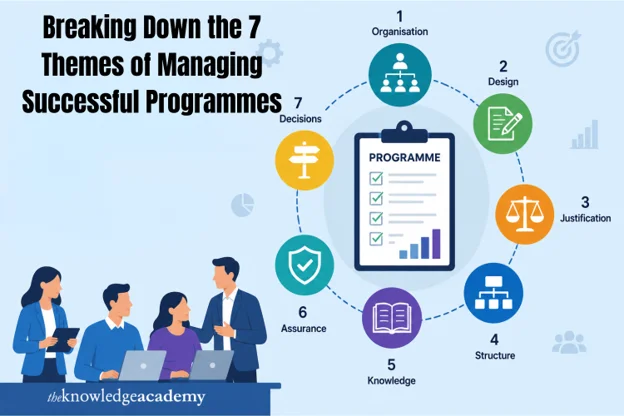
Breaking Down the 7 Themes of Managing Successful Programmes
Have you ever wondered why some large business transformation programmes run smoothly while others struggle with delays, confusion, and poor communication? Many professionals today explore MSP® Training to understand how successful programmes are managed across organisations. At the same time, learning about MSP® Risk Management helps teams handle uncertainty while keeping strategic goals on track.
Managing Successful Programmes focuses on more than project delivery. It creates a clear structure for long-term business change. One of the most important parts of this framework is its seven themes, which guide programmes from planning to successful outcomes.
In this blog, we will break down the seven MSP® themes and understand how each one supports better programme governance and decision-making across organisations.
Organization
Who is in charge of making important programme decisions? The Organization motif becomes significant at this point.
Establishing a transparent programme governance framework is the main objective of the Organisation theme. It outlines positions like Programme Manager, Business Change Leader, and Senior Responsible Owner. From the start, everyone involved is aware of their obligations.
Teams communicate better and are less confused when there is clear accountability. Throughout the course of a programme, organisations with robust governance frameworks frequently report improved collaboration and quicker decision-making.
Design
A strong future vision is essential for any successful programme. Creating such a future image is the main goal of the design theme.
This subject aids organisations in defining the Target Operating Model, which describes how the company should operate once the programme is over. Just like Fivebpeol, It determines the systems, procedures, capabilities, and enhancements required to accomplish strategic objectives.
Organisations may successfully complete projects but fall short of achieving significant business transformation in the absence of adequate design planning.
Justification
If the anticipated benefits were no longer present, would a programme still go on? That question is addressed in part by the Justification theme.
This theme guarantees that the programme will continue to provide value for the duration of its existence. Maintaining the business case, keeping an eye on expenses, evaluating anticipated benefits, and guaranteeing alignment with organisational strategy are its key objectives.
Strong financial oversight is crucial to MSP® Risk Management because it prevents organisations from squandering funds on programmes that are no longer worthwhile.
Frequent reviews also assist leadership teams in making well-informed decisions before issues worsen.
Structure
Without adequate planning, managing large programmes can quickly become challenging. Across all projects and delivery phases, the Structure theme aids in establishing order.
Programme planning, governance controls, resource management, and delivery coordination are the main topics of this theme. It presents the idea of tranches, which divide the programme into digestible phases.
Teams can monitor progress more frequently, change objectives, and manage risks more skilfully when work is managed in smaller segments. Additionally, this methodical approach increases adaptability in the event of unforeseen changes in company conditions.
Knowledge
How can businesses prevent making the same mistakes over and over again? The solution is found in the Knowledge topic.
This theme focuses on managing programme information, gathering lessons learned, and keeping correct records over the course of the programme. It establishes a trustworthy information source that facilitates improved decision-making.
Additionally, knowledge management enhances team coherence. Programme delivery is more effective and communication is clearer when everyone is working from the same information. This theme is particularly helpful in complicated transformation programmes involving several departments, according to several organisations that use MSP® Training frameworks.
Assurance
Independent oversight is necessary even for seasoned programme teams. An extra degree of assurance and control is offered by the Assurance theme.
This theme focuses on evaluating how well programme plans, policies, and governance procedures are being implemented. Additionally, it assesses the programme’s sustainability when business circumstances change.
Independent assurance aids in the early detection of problems before they have an impact on programme results or delivery schedules. Because leadership teams gain unbiased insights into programme performance, it also boosts stakeholder confidence.
Effective MSP® Risk Management methods and programme stability are greatly enhanced by robust assurance procedures.
Decisions
When decisions are delayed or escalations are unclear, programmes frequently fail. Organisations can sustain momentum by leveraging the decisions theme.
This topic outlines who is in charge, how decisions are made, and how problems should be escalated. Programme responsiveness is increased and delays are decreased with clear decision-making processes.
Programmes can adjust to shifting objectives while keeping costs, risks, and delivery expectations under control by making quick and well-informed decisions.
Stakeholder participation and programme governance are frequently improved in organisations with well-defined decision paths.
Conclusion
Managing successful programmes requires much more than delivering individual projects. The seven MSP® themes help organisations create structure, maintain governance, manage risks, and achieve meaningful business transformation. From Organisation and Design to Assurance and Decisions, each theme supports better programme control and long-term success.
Professionals looking to strengthen their programme management expertise and practical understanding of business transformation can build valuable skills through MSP® Training offered by one of the best training provider, The Knowledge Academy.