Why Is RAM So Expensive Now? The Real Story Behind The Price Surge
For years, RAM was one of the easiest PC components to upgrade without spending a fortune. Adding another 8GB or 16GB could often be done at a reasonable price, especially when memory manufacturers had plenty of supply. In 2026, however, shoppers are seeing a very different market. DDR4 and DDR5 kits can cost considerably more than expected, and even older memory is not always the budget-friendly option it once was.
So, why is RAM so expensive now?
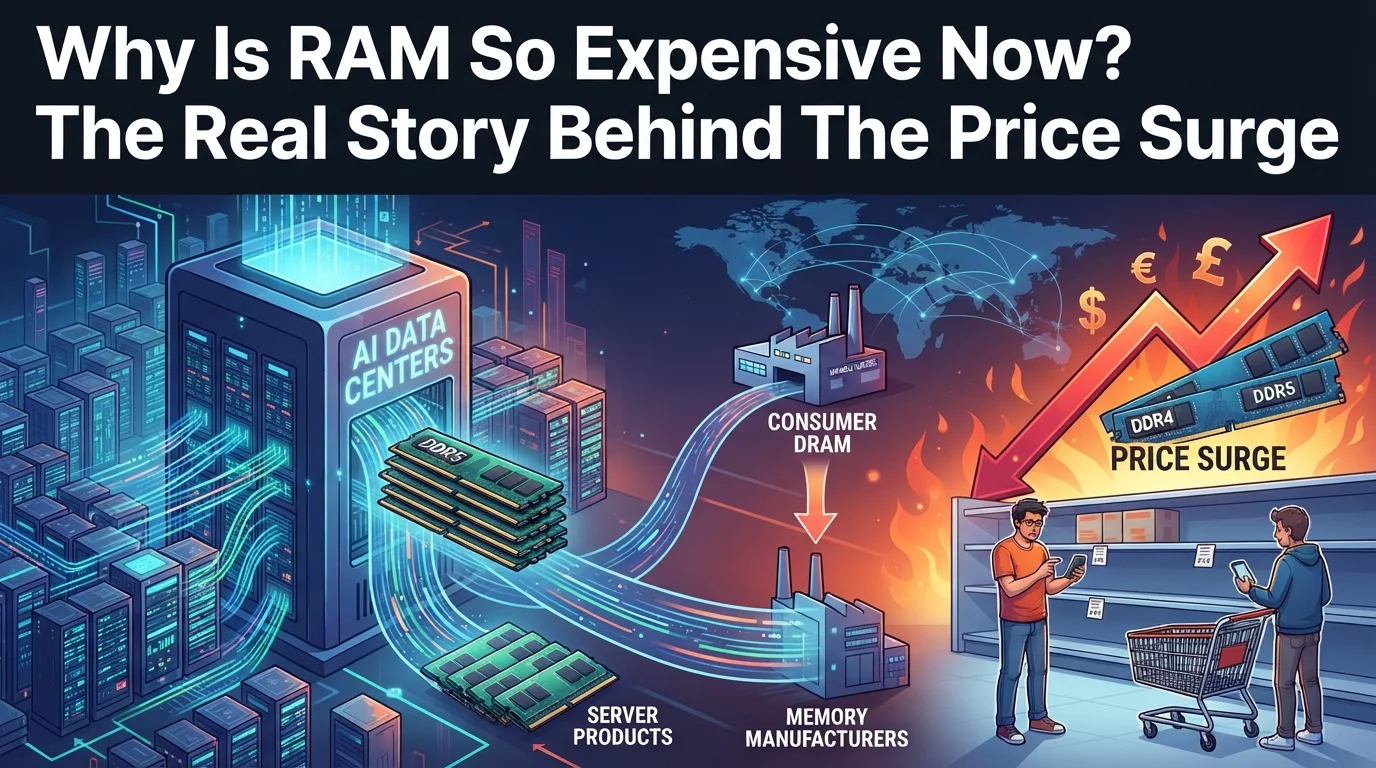
The answer starts with artificial intelligence, but it does not end there. AI data centers are consuming enormous quantities of memory, manufacturers are shifting production toward server and AI products, and the supply of conventional DRAM has become increasingly tight. At the same time, expanding semiconductor production takes years, making it difficult for suppliers to respond quickly when demand suddenly rises.
The current situation is therefore the result of several market forces working together rather than one isolated shortage.
Current RAM Price Trends
The RAM inside a gaming PC seems far removed from the servers running artificial intelligence. A desktop might have 16GB or 32GB of DDR5, while an AI data center uses specialized memory across thousands of servers.
Yet both belong to the same broader memory industry.
The companies producing DRAM have limited manufacturing capacity. They have to decide how much capacity goes toward desktop and laptop memory, server memory, mobile products, graphics memory, and newer technologies such as HBM.
Right now, the balance is moving heavily toward servers and AI-related applications.
TrendForce reported in September 2026 that DRAM suppliers’ inventories remained historically low and that additional supply was being directed mainly toward server applications. It also reported that consumer DRAM prices were seeing particularly strong pressure because suppliers had significantly reduced supply for that segment.
That helps explain why an ordinary PC buyer can suddenly face higher RAM prices even without buying anything related to AI.
AI And Memory Demand
Artificial intelligence has dramatically changed the amount of computing hardware required by large technology companies.
Training an AI model requires enormous amounts of data to be processed repeatedly. But the memory requirements do not disappear once training is finished. AI systems also need substantial memory capacity and bandwidth when answering users, generating content, processing data, and running automated tasks.
This transition from AI training toward large-scale inference is particularly important. More AI services are being deployed for everyday use, which means data centers need to handle a growing number of workloads continuously.
Micron said in June 2026 that AI workloads were expanding from training into large-scale inference, including reasoning-heavy and agent-based systems. The company also said memory content per server had doubled over the previous three years.
That creates a huge new source of memory demand.
The result is not simply that AI companies are buying more memory modules. Their demand is influencing how the entire memory industry allocates its available manufacturing capacity.
HBM Production
One of the most important pieces of the puzzle is HBM, or High Bandwidth Memory.
HBM is designed for extremely high memory bandwidth and is closely associated with modern AI accelerators. It is not the same thing as the DDR4 or DDR5 modules installed in a typical desktop, but its production still depends on the broader DRAM manufacturing ecosystem.
As AI accelerators become more powerful, they require more HBM. New generations of AI hardware are also increasing the amount of memory attached to individual processors.
TrendForce reported that HBM demand was continuing to grow through 2026 and that AI ASICs were becoming an important source of demand. The research firm also noted that HBM’s production requirements can crowd out conventional DRAM capacity.
This is a crucial part of understanding the current market.
When manufacturers devote more capacity to high-performance memory for AI systems, conventional DRAM can become harder to supply. The consumer does not have to be buying HBM for the shortage to affect the price of a normal RAM kit.
Server DRAM Demand
There is another change happening behind the scenes: memory manufacturers are giving greater attention to server products.
Large cloud companies and data-center operators buy memory in enormous quantities. Their orders can involve high-capacity RDIMMs and other specialized memory products needed for server systems.
These customers also tend to have long-term purchasing agreements and major infrastructure budgets. That makes the server market extremely important to memory manufacturers.
TrendForce reported in July 2026 that leading DRAM manufacturers were prioritizing server production, which was severely squeezing consumer DRAM supply. It also noted that limited near-term capacity additions were not enough to quickly fill the gap.
This shift has an obvious consequence for PC buyers: a smaller share of available production is being directed toward the consumer market.
That does not mean manufacturers have stopped making PC RAM. It means the consumer segment is operating in a much tighter supply environment.
DDR5 Supply And Pricing
DDR5 was already becoming the standard memory technology for newer computers. Modern desktop and laptop platforms increasingly use it, while older systems continue to rely on DDR4.
The problem is that DDR5 demand is arriving at the same time as strong demand from servers and AI infrastructure.
TrendForce said early in 2026 that strong server and AI demand was causing DDR5 capacity displacement and contributing to significant price increases.
This makes the current situation different from a simple consumer upgrade cycle.
If millions of people suddenly decided to upgrade their PCs, manufacturers could respond by increasing production over time. But today’s demand is coming from several markets simultaneously. Servers need memory, AI accelerators need HBM, new computers need DDR5, and other electronics continue to require DRAM.
The competition for available production therefore becomes much stronger.
DDR4 Supply Changes
It would be reasonable to assume that buyers could avoid expensive DDR5 by sticking with DDR4.
Unfortunately, the situation is more complicated.
DDR4 is an older technology, and manufacturers have been reducing production of some older and mature products. Once suppliers begin moving away from older memory generations, supply can become tighter rather than cheaper.
TrendForce reported in April 2026 that major suppliers were continuing to phase out production of mature products, while supply reductions and order transfers were contributing to higher consumer DRAM prices.
This creates an unusual pricing situation.
DDR5 can be expensive because demand is strong and production capacity is under pressure. DDR4 can also become expensive because manufacturers have less incentive to maintain large amounts of production for an older standard.
So simply choosing an older generation does not guarantee a bargain.
Semiconductor Manufacturing Capacity
One of the easiest solutions would seem to be increasing RAM production.
The problem is that semiconductor manufacturing does not work that quickly.
Building a modern memory fabrication facility requires huge amounts of capital and specialized equipment. The facility must then go through installation, testing, qualification, and production ramp-up before it can provide meaningful additional output.
That creates a major delay between recognizing a shortage and fixing it.
Memory companies are already investing in additional capacity, but those investments are aimed at medium- and long-term demand. They cannot instantly increase the number of RAM chips available in stores.
This is particularly important because AI demand has been growing quickly. If demand increases faster than new production can come online, the market remains tight.
DRAM Supply And Demand
There is also a traditional semiconductor cycle underneath the AI boom.
Memory prices have historically moved through periods of oversupply and shortage. When supply becomes excessive, prices fall, manufacturers reduce production, and investment can slow. When demand later returns, inventories decline and prices begin moving upward.
The current cycle has been intensified by AI.
Instead of recovering into a market where demand is mainly driven by PCs, smartphones, and ordinary servers, memory manufacturers are now dealing with enormous additional demand from AI infrastructure.
TrendForce reported that conventional DRAM contract prices rose sharply during the first half of 2026 and that suppliers’ inventories remained extremely low.
That combination of low inventory and strong demand gives suppliers much more pricing power than they would have in an oversupplied market.
AI Data Center Expansion
There is an interesting twist to the current situation: consumer demand itself is not necessarily booming.
High component prices are making PC and smartphone manufacturers more cautious. Some consumers may also delay upgrades when they see expensive memory prices.
Yet RAM prices can continue rising because the supply side is so constrained.
TrendForce reported in July that consumer affordability limits were becoming more noticeable as memory contract prices reached record levels. It still expected conventional DRAM prices to rise in the third quarter of 2026, although at a slower rate than earlier in the year.
In other words, weaker consumer demand does not automatically create cheap RAM when manufacturers are simultaneously reducing consumer-focused supply and prioritizing other markets.
When RAM Prices Could Fall?
Another reason the situation can be confusing is that there is no single global price for RAM.
Different memory products have different supply conditions.
A 16GB desktop DDR5 kit, a 32GB server RDIMM, laptop SO-DIMM memory, DDR4 modules, and HBM all belong to different segments. Their prices can move at different speeds depending on production, demand, specifications, and contracts.
Even within desktop memory, speed and capacity matter.
For example, TrendForce’s September 2026 pricing data showed continued movement in both DDR4 and DDR5 memory markets, while server RDIMM pricing was operating in a very different range from consumer modules.
That is why one RAM kit may suddenly become much more expensive while another changes only slightly.
What Consumers Should Know?
The biggest difference between today’s market and previous RAM price increases is the scale of AI infrastructure.
Traditional computing growth was spread across millions of PCs, phones, and servers. AI infrastructure is adding another enormous layer of demand, with each generation of hardware requiring increasingly sophisticated memory systems.
Memory is becoming a strategic component rather than simply another inexpensive part of a computer.
Companies building AI infrastructure are willing to secure memory supplies well ahead of time. This can make it harder for consumer-focused buyers to compete for limited production.
TrendForce has already projected that AI will remain the primary driver of memory demand into 2027, with continued HBM allocation and strong AI-server demand expected to keep DRAM supply constrained.
That suggests the current situation is not merely a short-term retail pricing problem.
When Could RAM Prices Start Falling?
There is no guaranteed date when RAM will suddenly become cheap again.
Prices ultimately depend on the balance between production and demand. If manufacturers successfully bring additional capacity online faster than demand grows, supply pressure should ease. If AI infrastructure continues consuming new capacity at a rapid pace, however, the market could remain tight for longer.
The current outlook already suggests that price increases may moderate even while prices remain elevated. TrendForce’s third-quarter 2026 forecast expected DRAM contract prices to continue increasing, but at a slower rate because consumer buyers were reaching their affordability limits.
That distinction matters.
A slower increase is not the same thing as a price drop. RAM can stop becoming dramatically more expensive without immediately returning to the prices consumers remember from previous years.
Conclusion
The short answer to why is ram so expensive now is that the memory industry is dealing with an unusually strong demand cycle while available supply remains restricted.
AI servers are demanding huge amounts of memory. HBM production is consuming valuable DRAM capacity. Server customers are receiving greater priority from manufacturers. Consumer DRAM production has been reduced in some areas, while older memory technologies are also being phased out. At the same time, new semiconductor capacity cannot be built quickly enough to immediately solve the imbalance.
That combination has pushed the price of memory far beyond what many PC buyers are accustomed to.
The situation is not simply about companies charging more for a popular computer component. It reflects a much larger transformation in the semiconductor industry, where memory has become one of the critical resources powering the expansion of AI and modern data centers.
Until production catches up with demand, the price of a simple RAM upgrade will continue to reflect what is happening far beyond the walls of an ordinary PC.