
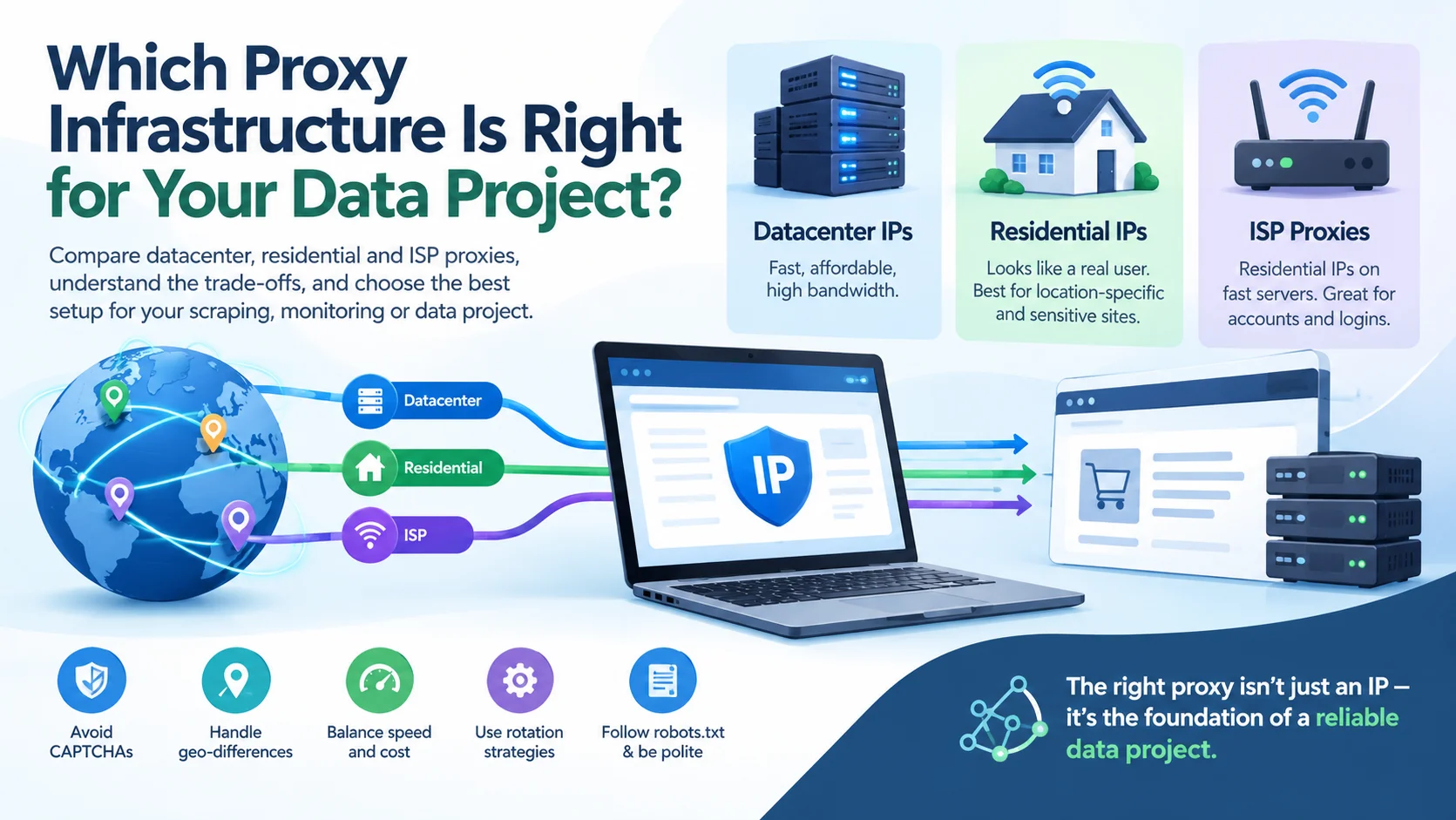
Which Proxy Infrastructure Is Right for Your Data Project?
Scrapers rarely die on day one. They die on a Tuesday afternoon, three weeks in, when somebody notices the price dashboard has been showing the same numbers since Friday because the target site started feeding the bot a CAPTCHA page.
Nine times out of ten the proxies are to blame, or at least the choice of proxies. Pulling census tables off a government portal and tracking product prices in 30 countries are very different jobs, and they shouldn’t run on the same setup.
Picking well isn’t complicated. It mostly means doing things in the right order.
Check the Site First
People tend to shop for a proxy plan and then go look at the site. Flip that. How strict the target is (and whether it changes content by location) will settle most of the decision for you.
Testing it costs almost nothing. Send a couple hundred requests from a single IP and watch what comes back, because a pile of 403 and 429 errors early on means a plain server IP won’t last. After that, open the same page from your own home connection and compare the two; if the prices or listings don’t match, the site is reading locations.
At that point you’re really choosing between datacenter and residential IPs. IPRoyal has a decent write-up on the residential proxy vs datacenter proxy trade-offs, but it boils down to whether the site cares where a visitor is connecting from.
Datacenter IPs
These come from server farms run by hosting companies like AWS, Hetzner or OVHcloud. Cloudflare, Akamai and similar bot filters know those address ranges well, so plenty of sites will challenge that traffic on sight.
Doesn’t make them useless, though. Far from it.
Plenty of jobs never touch a picky site anyway (public APIs, open data portals, uptime monitoring, testing your own staging environment). Pricing is usually per IP with a lot of bandwidth thrown in, which matters if you’re pulling something like 500 GB of pages a month, because on residential plans billed by the gigabyte that bill gets ugly fast.
Residential IPs
A residential IP belongs to an ordinary home internet plan from Comcast, Vodafone, Deutsche Telekom or whoever. The site sees what looks like a person on a laptop. That’s the whole appeal.
Price monitoring, checking that ads actually show up in the right city, local search rankings: these tend to need it. A shop in Germany can quote one price to someone browsing from Munich and another to a server in Frankfurt, and without a local IP you’d never catch the difference.
They do cost more, usually per gigabyte. They’re slower too, and now and then a session drops because the device on the other end got switched off, so build in retries from the start.
Ask where the IPs come from before you sign anything. Back in 2019, a paper at the IEEE Symposium on Security and Privacy showed some residential networks were running on people’s devices without their knowledge, which is not something you want your project tied to.
Putting It Together
There’s a third option people forget about. ISP proxies (sometimes sold as static residential) are registered like home connections but sit on proper servers, so they’re fast and they keep the same IP for hours, which suits account work nicely.
Rotation deserves some thought as well. A big product crawl can switch IPs on every request without trouble, while anything involving a login or a cart needs the same IP for the whole session. Scrapy, Playwright and Puppeteer all send HTTPS through a proxy using the CONNECT method, and MDN’s page on proxy servers and tunneling covers what’s going on under the hood.
Expect sites to keep tightening up. Bots accounted for 51% of all web traffic in 2024 according to the 2025 Imperva Bad Bot Report from Thales, the first year in a decade that humans were outnumbered.
And be polite about it. Sticking to what a site’s robots.txt allows (Google has a plain-English introduction to robots.txt if you need one) and slowing down your request rate will often do more good than upgrading to pricier IPs.
Where This Is Going
Teams that have been at this a while almost always land on a mix. Cheap datacenter IPs do the heavy lifting, and residential or ISP addresses get saved for the handful of sites that fight back.
The IP itself will probably count for less over time. Bot filters already look at TLS fingerprints, header order and how a visitor clicks around, so the scrapers that keep working will be the ones whose traffic simply looks like a person browsing.