Japanese Family Names Meaning and History Explained
Growing up fascinated by different cultures, I often tried to find patterns in how identities are shaped, and exploring Japanese family names became one of my favorite parts of that journey. When I first came across a directory that listed the most popular Japanese surnames from A to Z, it felt like stepping into a blend of history and personal stories. Each Japanese last name carries a deep meaning, whether inspired by nature, places, or ancestral roles, and discovering their origin helped me learn how families preserved their heritage across generations.
While guiding students through cultural research for Family Education, I noticed how eager they were to connect names with their backgrounds. Looking up Japanese family names became more than a task; it created a sense of curiosity and respect. Even today, I enjoy revisiting these collections because every name, whether common or rare, reveals something timeless about tradition and identity.
How Japanese Family Names Developed and What They Mean
When I first studied old Japanese history, I was amazed at how Japanese families in 300 BC lived in carefully organized clans, each known by clan names like the uji (氏). These early groups often chose names linked to geographical features, occupations, or famous members, and some grew so powerful that the Yamato clan became the strongest, eventually uniting the early kingdom.
Their ranking system, the kabane (姓), acted like an aristocratic title, and the combination of uji-kabane formed a clear way to designate social groups. I remember reading how many from the noble class and samurai families carried these early family names. In contrast, common people mostly used only given names, often tied to their village of origin.
Common Japanese Family Names and Their Meanings
Here are some of the most common Japanese surnames that continue to appear across the country today:
| Family Name | Meaning |
| 佐藤 (Sato) | Assist + wisteria |
| 鈴木 (Suzuki) | Bell tree |
| 高橋 (Takahashi) | High bridge |
| 田中 (Tanaka) | Middle of the rice fields |
| 渡辺 (Watanabe) | To cross over / ferry across |
| 伊藤 (Ito) | Exceptional wisteria |
| 山本 (Yamamoto) | Base of the mountain |
| 中村 (Nakamura) | Middle village |
| 小林 (Kobayashi) | Small forest |
| 吉田 (Yoshida) | Lucky / good rice field |
| 山口 (Yamaguchi) | Mountain entrance |
| 松本 (Matsumoto) | Base of the pine tree |
| 佐々木 (Sasaki) | Assistant of wisteria |
| 山田 (Yamada) | Mountain rice field |
| 井上 (Inoue) | Above the well |
| 木村 (Kimura) | Tree village |
| 清水 (Shimizu) | Clear water |
| 林 (Hayashi) | Forest |
| 森 (Mori) | Woods / forest |
| 加藤 (Kato) | Increase + wisteria |
Japanese Family Names With Dark Meanings
Some Japanese surnames carry shadows in their meanings, echoing old legends, harsh landscapes, or memories of conflict. These names aren’t common in everyday life, but they survive in literature, folklore, and historical records.
Their tone ranges from eerie and mysterious to downright ominous, making them favorites among writers and linguists. These darker surnames reveal how deeply symbolism and storytelling are woven into the Japanese language.
| Name | Meaning |
| 黒石 (Kuroishi) | Black stone; associated with mystery |
| 悪魔 (Akuma) | Demon / evil spirit |
| 闇岡 (Yamioka) | Dark hill; shadowed landscape |
| 死神 (Shinigami) | God of death; folklore name |
| 黒川 (Kurokawa) | Black river |
| 影山 (Kageyama) | Shadow mountain |
| 鬼頭 (Onitō) | Demon head; fierce imagery |
| 血川 (Chikawa) | Blood River; symbolic, fictional |
| 骸谷 (Mukurodani) | Valley of corpses; mythic tone |
| 黒門 (Kuromon) | Black gate |
| 闇島 (Yamishima) | Dark island; cursed-like imagery |
| 狼谷 (Ōkamiya) | Wolf Valley; danger theme |
| 朧塚 (Oborozuka) | Hazy grave mound |
| 呪田 (Noroi Ta / Juta) | Cursed field |
| 黒峰 (Kuromine) | Black peak |
| 獄野 (Gokuno) | Hell field |
| Toma (冬真) | True winter |
These rare and shadow-tinged surnames aren’t part of modern naming trends, but they carry a fascinating weight.
They appear in folktales, period dramas, supernatural fiction, and artistic pen names. Exploring them offers a glimpse into Japan’s darker mythological layers and the poetic emotion behind traditional naming culture.
Japanese Family Names Meaning “Moon”
When I explore Japanese surnames, I often check how kanji shape their stories, and sometimes I find Moon themes hidden below the surface, especially in names that include symbols whose meaning feels even closer to the sky.
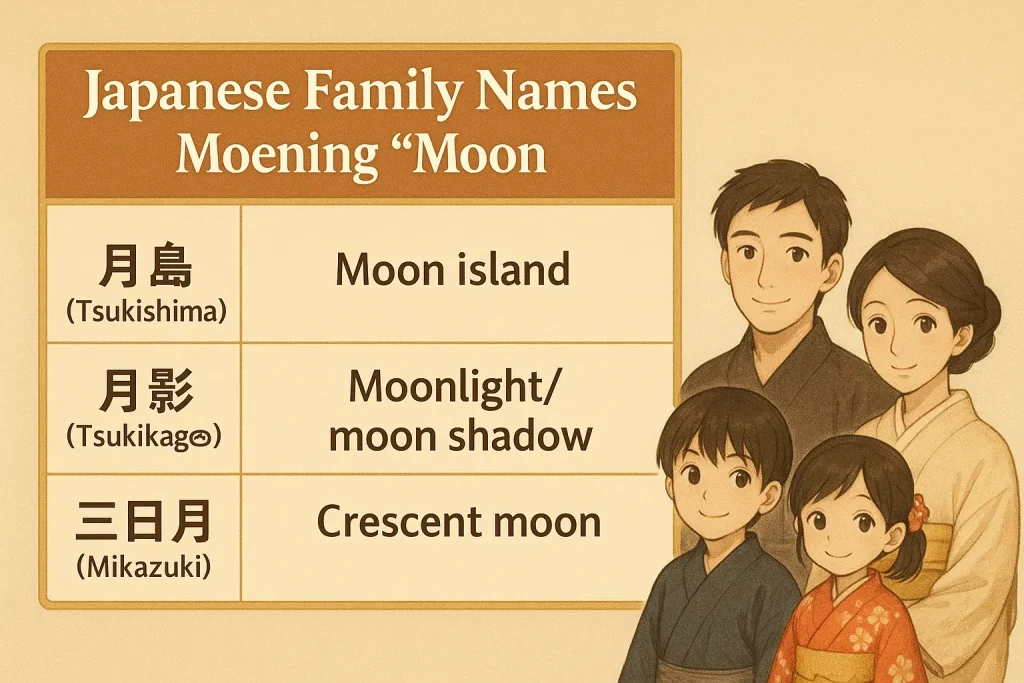
In my notes, the list shows how earlier a kanji appears, the more exact its meaning, and I enjoy comparing these layers to understand how families chose characters that felt personally meaningful.
| Name | Meaning |
| 月島 (Tsukishima) | Moon island |
| 月影 (Tsukikage) | Moonlight/moon shadow |
| 三日月 (Mikazuki) | Crescent moon |
| 月野 (Tsukino) | Field of the moon |
| 月山 (Tsukiyama) | Moon mountain |
| 月森 (Tsukimori) | Moon forest |
| 月岡 (Tsukioka) | Moon hill/moon ridge |
| 月田 (Tsukita / Tsukida) | Moon rice field |
| 月本 (Tsukimoto) | Origin/base of the moon |
| 月光 (Gekkō / Gekkou) | Moonlight |
| 月原 (Tsukihara) | Moon meadow/plains |
| 月見 (Tsukimi) | Moon viewing |
| 名月 (Meigetsu) | Bright moon/harvest moon |
| 月浦 (Tsukiura) | Moon Bay / Moon Inlet |
| 月村 (Tsukimura) | Moon village |
The beauty of moon-themed Japanese surnames lies in their soft, poetic imagery and deep cultural symbolism. Each name carries a sense of elegance, mystery, and connection to nature.
These lunar-inspired family names remain favorites among writers, creators, and families who appreciate the gentle glow of tradition.
Japanese Samurai Family Names
Understanding Japanese samurai surnames means looking beyond simple family labels. Early Imperial records preserved clan identity through uji-na (氏名) and honsei (本姓), which marked ancestral origins. This later evolved into myōji (名字 / 苗字), used to distinguish lineages, territories, and official roles.
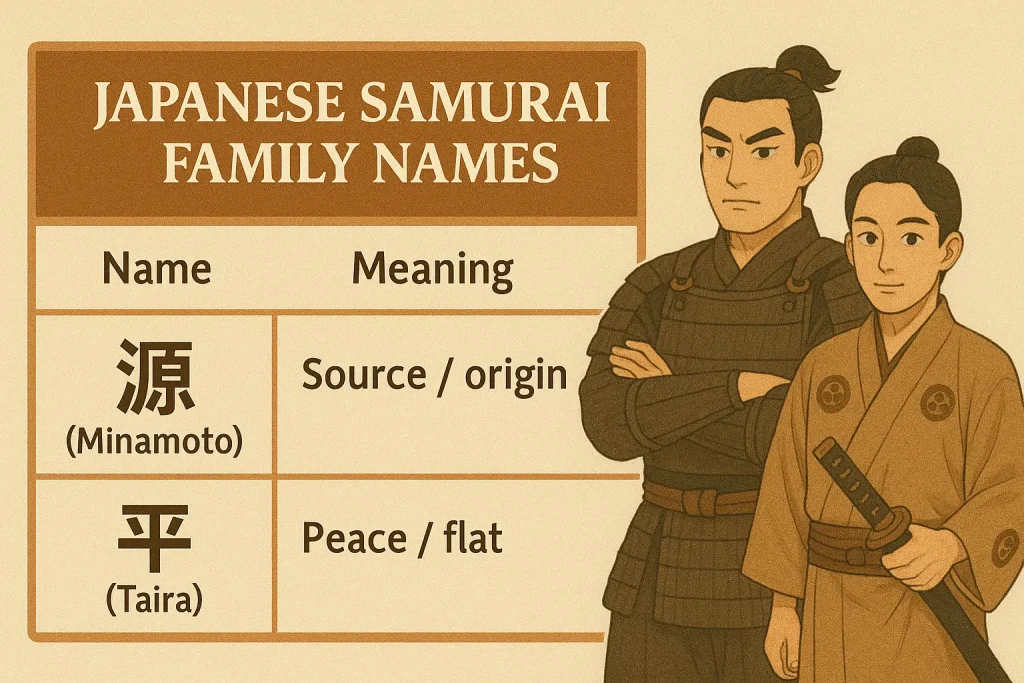
Samurai families, aristocratic houses, and kuge nobles relied on these names to assert authority, define positions such as Shugo, Shugodai, and Jitō, and protect their 家名 (kamei), the core of their hereditary prestige. As a result, samurai surnames still carry a strong sense of history and legacy, and many of the most iconic examples can be seen in the list below.
| Name | Meaning |
| 源 (Minamoto) | Source / origin |
| 平 (Taira) | Peace / flat |
| 藤原 (Fujiwara) | Wisteria field |
| 上杉 (Uesugi) | Upper cedar |
| 伊達 (Date) | Elegant / refined |
| 武田 (Takeda) | Warrior + rice field |
| 織田 (Oda) | Woven rice fields |
| 北条 (Hōjō) | Northern castle |
| 細川 (Hosokawa) | Narrow river |
| 島津 (Shimazu) | Island haven / island port |
| 真田 (Sanada) | True field |
| 毛利 (Mōri) | Thick forest |
| 長宗我部 (Chōsokabe) | Long ancestor family |
| 浅井 (Asai / Azai) | Shallow well |
| 立花 (Tachibana) | Mandarin orange flower |
| Jin (仁) | Kindness with power |
| Sho (翔) | To soar freely |
Family Names in Japanese vs. Given Names
In Japanese culture, the family name comes first, followed by the given name.
For example:
Japanese Family Member Names (Vocabulary)
If you’re studying Japanese or exploring family histories, these terms help identify family relationships:
These Japanese family member names are essential for understanding familial structures in daily speech and genealogical research.
Why Japanese Family Names Are So Distinctive
What makes Japanese surnames especially fascinating is their poetic structure. They often combine:
This creates a naming system that is visually descriptive and culturally meaningful perfect for anyone writing stories, doing genealogical research, or simply exploring global surnames. A Japanese Name Generator can be useful for exploring these naming patterns without changing their traditional meaning.
Final Thoughts
Japanese family names create a meaningful bridge between the past and the present, carrying echoes of nature, history, and ancestry into everyday life. Whether shaped by landscapes, legends, or ancient clans, each name reveals how families once understood their place in the world. Exploring these meanings turns simple kanji into living stories. Through them, we glimpse the values and beauty that shaped Japanese identity across generations.
From moon-inspired names to dark, mythic ones and proud samurai lineages, the variety within Japanese surnames demonstrates the expressive and enduring nature of this tradition. Every surname carries emotional heritage, mystery, harmony, or strength. Studying them invites a deeper appreciation for Japan’s cultural roots. And in every character, a legacy continues to shine through modern life.