Japanese Surnames Explained History Meanings And Hidden Beauty
When I first got curious about Japanese naming culture while living in Japan, I noticed how everyday dealings with friends from Japanese communities revealed a blend of Western customs and deeply rooted traditions; even when people traveled abroad, some still preferred the traditional order where the surname comes first, despite the regular use of the Western style, and I found myself comparing names written with kanji characters to their characters in English to understand their layered meanings.
As a hobby linguist, I kept a small list of surnames I encountered in the world, fascinated by how kanji, plants, places, and natural features shaped them, while others followed an unusual pattern with rare combinations and surprising pronunciations that only a handful of people, sometimes fewer than 100, actually used.
And even though I was still learning, comparing original names from different regions of Japan helped me appreciate how deeply personal and cultural these surnames are, whether formed from two simple symbols or something far more intricate.
Why Japanese Surnames Are So Meaningful
Unlike many Western surnames that trace lineage or occupation, Japanese surnames often come directly from nature, geography, or ancient clan origins. This gives them a poetic feel; many names read like tiny pieces of art.
Some common themes include:
Because Japanese surnames were standardized in the late 19th century (during the Meiji Restoration), many people chose family names inspired by their surroundings, meaning two unrelated families might share a surname simply because they lived near the same landscape.
Common Japanese Family Names and Their Meanings
My early curiosity about Japanese family history led me to discover that surnames branch into about 291,129 unique forms, each shaped by layered kanji meanings and the older system of 姓 (sei). Many are written in one form but pronounced differently, or appear the same in characters while coming from different roots.
An old August study from Meiji, based on 6,118,000 customers of an Insurance Company, revealed that the top 10% of the population shares the most common lines, and the top 100 cover about 33%, all eventually romanized into the versions used today. Those findings came from Yasuda’s data and the broader Yasuda Life surname ranking, which showed how certain names appear similarly across Japan.
Conversely, others connect to old land systems, family duties, or even annuities tied to clan history. While helping a friend trace his line of 10 ancestors, I noticed familiar patterns reflected in everyday culture,watanabe, one of the surnames you’ll spot throughout anime, dramas, and daily life in Japan.
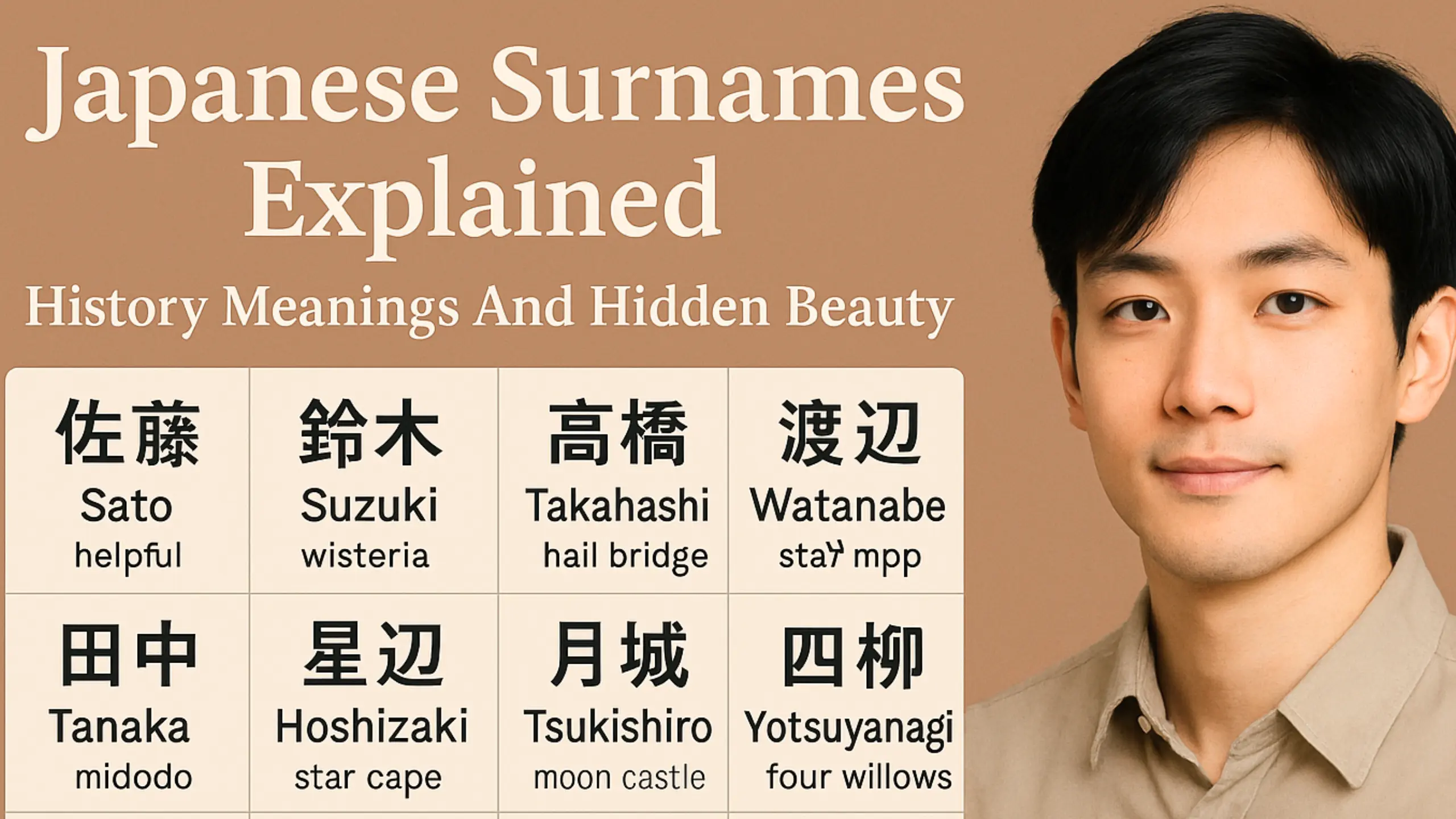
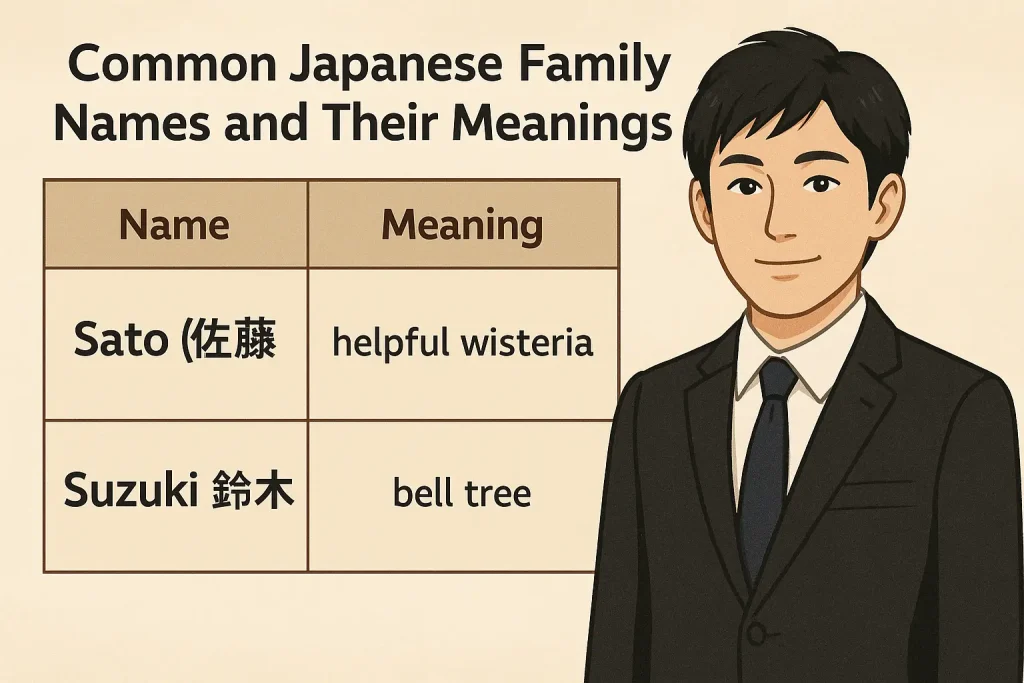
Meaning: “helpful wisteria” or “assistant of the Fujiwara clan”
One of the most common Japanese surnames, tied to the influential Fujiwara family.
Meaning: “bell tree” or “bell wood”
A gentle, musical-sounding surname.
Meaning: “high bridge”
Often linked to families living near elevated bridges.
Meaning: “middle of the rice field”
Visually rich and very traditional.
Meaning: “ferry crossing”
Historically linked to families who worked near ports or crossings.
These popular Japanese surnames remain top-ranked across the country.
Rare Japanese Surnames You Hardly Ever See
Japan has thousands of surnames classified as rare. Some exist only within a few families. These rare Japanese surnames often come from old clans, obscure geographic features, or archaic kanji.
Meaning: “star cape”
Evokes dramatic coastal imagery.
Meaning: “meat door/gate”
Not as morbid as it sounds — the kanji historically referenced hunting regions.
Meaning: “moon castle”
Beautiful, romantic, and very uncommon.
Meaning: “black feathers”
A surname with dark elegance.
Meaning: “four willows”
Complex kanji, rarely used today.
These uncommon Japanese surnames add a sense of mystery perfect for fiction, pen names, or character creation.
Unique Japanese Surnames With Striking Imagery
If you’re searching for unique Japanese surnames that stand out, check out these poetic options; they pair beautifully with Japanese Boy Names and give characters a strong, artistic feel:
These names aren’t super rare, but they carry distinctive imagery that makes them feel special.
Japanese Surnames Meaning Moon
Japanese names involving the moon always strike a mystical, gentle tone. Here are some Japanese surnames meaning moon or related to lunar imagery:
Any of these make gorgeous, ethereal character names.
Japanese Surnames with Dark Meanings
If you’re hunting for edgier or gothic vibes, these Japanese surnames with dark meanings deliver:
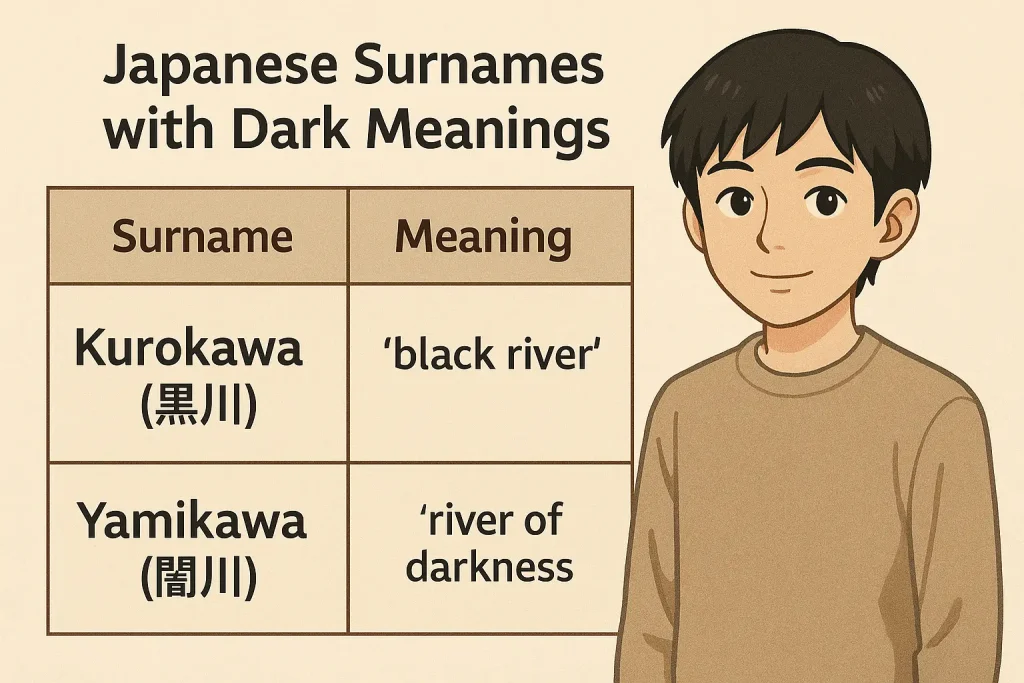
Perfect for fantasy, horror, anime, or dramatic storytelling.
Royal Japanese Surnames & Noble Lineage Names
- 1. Fujiwara (藤原)
One of the most dominant aristocratic families in Japanese history.
- 2. Minamoto (源)
Powerful clan, ancestors of many shoguns.
- 3. Taira (平)
Ancient samurai clan, rivals of the Minamoto.
- 4. Tachibana (橘)
Aristocratic family name meaning “citrus.”
- 5. Oda (織田)
Linked to the famous daimyo Oda Nobunaga.
These surnames carry weight and historical legacy.
Uncommon Japanese Surnames
Here are some uncommon Japanese surnames that aren’t extremely rare, but still unique enough to stand out:
Great choices for storytelling or personal use.
List of Japanese Surnames (Wide Variety)
Here’s a broader list of Japanese surnames mixing common, rare, elegant, and nature-based names:
| Name | Meaning |
| Aoyama (青山) | blue/green mountain |
| Yamamoto (山本) | base of the mountain |
| Mori (森) | forest |
| Inoue (井上) | above the well |
| Hashimoto (橋本) | base of the bridge |
| Kobayashi (小林) | small forest |
| Ishikawa (石川) | stone river |
| Kirishima (霧島) | misty island |
| Hayasaka (早坂) | early slope |
| Kamiyama (神山) | divine mountain |
Japanese Male Names and Surnames
If you’re creating characters or exploring name combos, here are Japanese male names and surnames that flow well together:
Male Given Names:
| Name | Meaning |
| Haruto (陽斗) | sunny soar |
| Ren (蓮) | lotus |
| Daichi (大地) | great earth |
| Yuto (優斗) | gentle warrior |
| Kaito (海斗) | sea person |
Combined With Matching Surnames:
| Name | Meaning |
| Haruto Tsukiyama | bright boy + moon mountain |
| Kaito Fujikawa | sea boy + wisteria river |
| Ren Yamamoto | lotus + mountain base |
| Daichi Kurobane | earth + black feathers |
| Yuto Takahashi | gentle + high bridge |
These combos feel natural and authentic.
Japanese Female Names and Surnames
Now, let’s look at Japanese female names and surnames that pair beautifully:
Female Given Names:
| Name | Meaning |
| Aiko (愛子) | beloved child |
| Sakura (桜) | cherry blossom |
| Yuna (優奈) | gentle |
| Hikari (光) | light |
| Mio (美桜) | beautiful cherry |
Name Pairings:
| Name | Meaning |
| Sakura Tsukimori | cherry blossom + moon forest |
| Aiko Hanabusa | beloved + flower cluster |
| Hikari Aoyama | light + green mountain |
| Yuna Natsukawa | gentle + summer river |
| Mio Tachibana | beautiful cherry + noble family citrus |
Final Thoughts
Japanese surnames feel like tiny windows into how people once saw the land, their families, and their place in the world. Even today, whether a name points to a river, a season, or an ancient clan, it carries a little echo of history that quietly lives on in everyday life. That mix of meaning and simplicity is part of what makes exploring them so addictive you’re not just reading kanji; you’re reading a story.
And as naming styles keep blending tradition with modern influence, these surnames stay surprisingly resilient. Common or rare, poetic or understated, each one maps out a small corner of Japan’s cultural landscape. The more you learn, the more you start to notice patterns, quirks, and the gentle artistry woven into names people use without even thinking about it.