
LoL Tier List – A Practical Guide to Champion Rankings
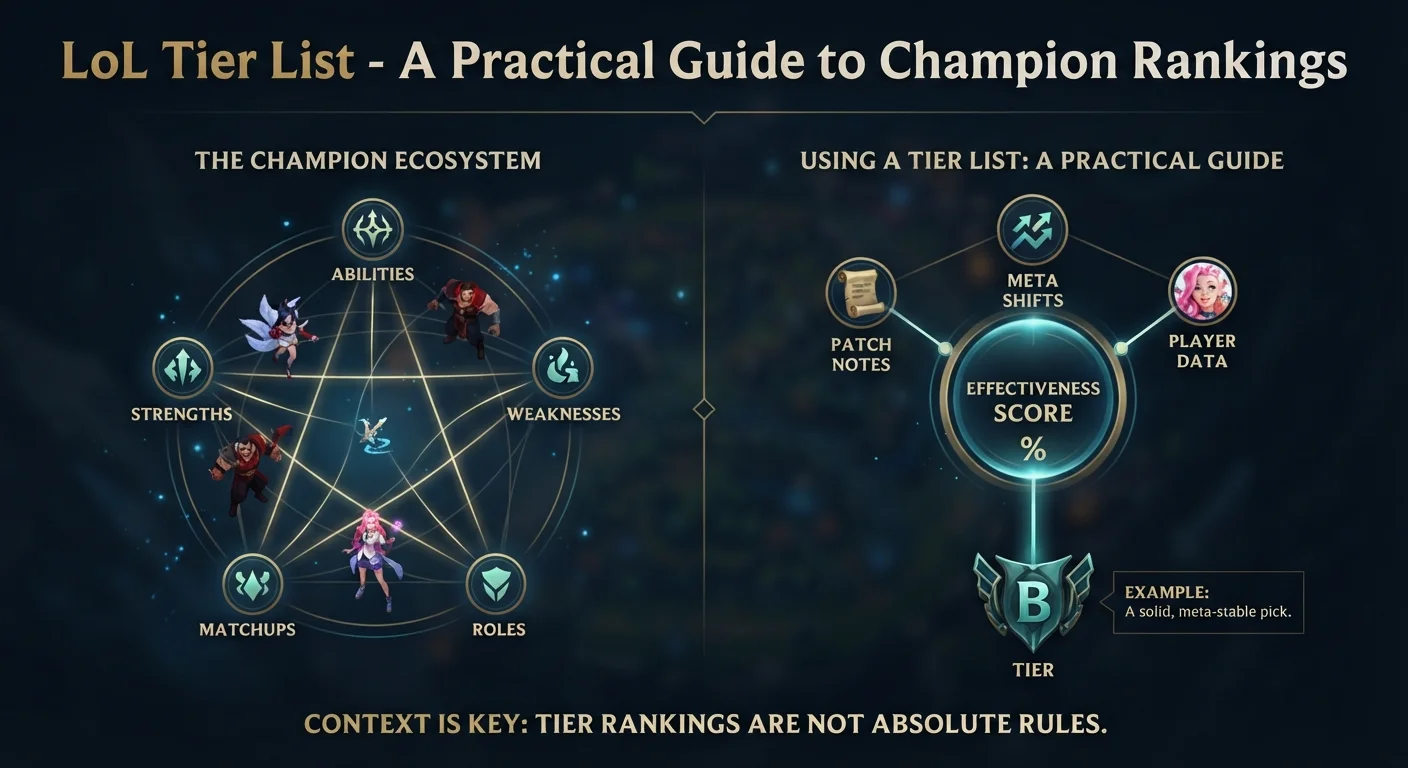
League of Legends has a huge champion roster, and choosing the right champion can sometimes be harder than learning how to play one. Every champion has different abilities, strengths, weaknesses, matchups, and roles. This is where a LoL tier list becomes useful.
A tier list organizes champions according to their overall effectiveness in a particular role or environment. Instead of looking at every champion individually, players can quickly see which picks are performing well and which ones may require more effort to succeed with. However, tier rankings are not absolute rules.
A champion placed lower on a list can still be extremely effective when played by someone who understands that champion well.
What Is a LoL Tier List?
A LoL tier list is a ranking system that places League of Legends champions into different levels according to their current strength, usefulness, and performance. The rankings are usually divided into categories such as S, A, B, C, and sometimes D.
The highest tiers generally contain champions that perform consistently well under current game conditions. Lower tiers may contain champions with more weaknesses, difficult matchups, lower overall performance, or a greater dependence on player skill.
Most tier lists are separated by position because a champion’s value can change significantly depending on where they are played. The five main positions are:
- Top
- Jungle
- Mid
- Bot or ADC
- Support
This separation makes rankings more useful because it compares champions within the same role rather than treating the entire roster as one group.
How Champions Are Ranked?
Champion rankings are not normally based on a single statistic. Several factors can influence where a champion appears on a tier list.
Win Rate and Overall Results
Win rate is one of the most commonly considered measurements. If a champion consistently wins a high percentage of games, that can indicate strong performance. However, win rate alone does not tell the entire story.
A champion may have a high win rate because experienced players use that champion frequently, while another champion might have a lower win rate because beginners choose it more often. For this reason, tier lists usually consider several forms of data together.
Pick Rate and Ban Rate
Pick rate shows how frequently players select a champion, while ban rate indicates how often players prevent that champion from being selected.
A champion with a high pick and ban rate may be particularly influential in the current environment. Players may consider the champion powerful, difficult to deal with, or highly effective in certain team compositions.
These numbers also provide useful context. A champion with strong results and significant player interest may deserve a higher ranking than one with similar results but very limited usage.
Matchups and Champion Difficulty
Matchups are another important part of champion evaluation. Some champions may perform extremely well against popular opponents but struggle against specific counters.
Difficulty also matters. A mechanically demanding champion may have tremendous potential in experienced hands while producing weaker results among less experienced players. A tier list therefore does not always represent the maximum potential of a champion. It often reflects how reliably players can achieve good results with that pick.
Understanding Different Tier Levels
The letters used in rankings are simple, but their meaning can vary between different websites and creators.
S Tier
S-tier champions are generally considered among the strongest choices for their position. They often have useful abilities, reliable performance, strong matchups, or valuable contributions to their team.
This does not mean every S-tier champion will win every game. Draft choices, player skill, team coordination, and individual mistakes still have a major effect on the outcome.
A Tier
A-tier champions are strong and dependable options but may have slightly more limitations than the highest-ranked picks. They can still perform exceptionally well and are often excellent choices for players who are comfortable with them.
In many situations, the difference between an S-tier and A-tier champion can be relatively small.
B and C Tier
B-tier champions are generally viable but may have more noticeable weaknesses or fewer advantages in the current environment. They can still be successful when used correctly.
C-tier champions may require more specific conditions to perform well. They can have useful strengths, but their weaknesses, difficult matchups, or lower consistency can make them less attractive choices for players focused purely on maximizing their chances of success.
Why Do Tier Lists Change Over Time?
League of Legends is constantly updated. Champion abilities, items, runes, objectives, and other gameplay systems can change from one patch to another.
A champion that performs exceptionally well after one update may become weaker after receiving a nerf. Likewise, an underused champion can suddenly become popular after a buff or an item change.
The overall game environment also affects rankings. Even when a champion receives no direct changes, alterations to other champions or items can indirectly improve or reduce its effectiveness.
For this reason, a LoL tier list should always be connected to a particular patch or period. Using an old ranking as if it represents the current game can lead to poor champion choices.
How Players Should Use a Tier List?
Tier lists are most useful when treated as a source of guidance rather than a strict instruction manual.
Start With Your Preferred Role
First, identify the position you normally play. There is little benefit in choosing a highly ranked champion for a role you rarely play if you are much more comfortable somewhere else.
Once you know your position, compare the champions within that role and look for picks that match your preferred playstyle.
Consider Your Champion Experience
A champion’s ranking should not automatically override your own experience. If you have played one champion for hundreds of games and understand its abilities, matchups, and mechanics, you may perform better with it than with a supposedly stronger champion you have barely played.
A practical approach is to use rankings to discover potential picks while relying on personal experience to make the final decision.
Look Beyond the Letter
Do not focus only on whether a champion is S or A tier. Look at why the champion received that ranking.
Useful information includes:
- Strong and weak matchups
- Difficulty level
- Recommended builds
- Current win rate
- Pick and ban rates
- Performance across different skill levels
- Strengths and weaknesses
This gives a much clearer picture than a single letter.
Are Tier Lists Always Accurate?
No tier list can perfectly predict the result of an individual match. Rankings are based on available data, analysis, or the opinion of the person creating the list. Different sources can therefore place the same champion in different tiers.
Player skill is one of the biggest reasons for these differences. Someone who specializes in a particular champion may achieve excellent results even when that champion has an average ranking.
Team composition matters as well. League of Legends is a team-based game, so a champion’s effectiveness can change depending on the abilities of teammates and opponents.
The best way to interpret rankings is to treat them as a snapshot of the current competitive environment rather than a permanent judgment of champion quality.
Tier Lists for Different Skill Levels
Champion strength can vary between ranks. A champion that dominates lower-ranked games may be less effective at higher levels where players understand how to counter it.
Likewise, some champions become more valuable as players improve because their abilities offer greater strategic or mechanical potential.
When using a LoL tier list, players should therefore check whether the rankings are intended for their approximate skill level. A list designed for beginners may emphasize easy and reliable champions, while a high-rank list may place more importance on advanced mechanics, coordinated play, and competitive matchups.
Final Thoughts
A tier list is a convenient way to understand the current League of Legends environment and discover champions worth trying. It can highlight strong picks, explain changes in champion popularity, and help players make more informed decisions during champion selection.
Still, rankings should never replace personal knowledge and practice. The strongest choice on paper is not necessarily the strongest choice for every player. Understanding a champion, knowing its matchups, and making good decisions during a game can matter just as much as its position on a ranking.
Used properly, a LoL tier list is best viewed as a starting point for research rather than a guarantee of victory.