
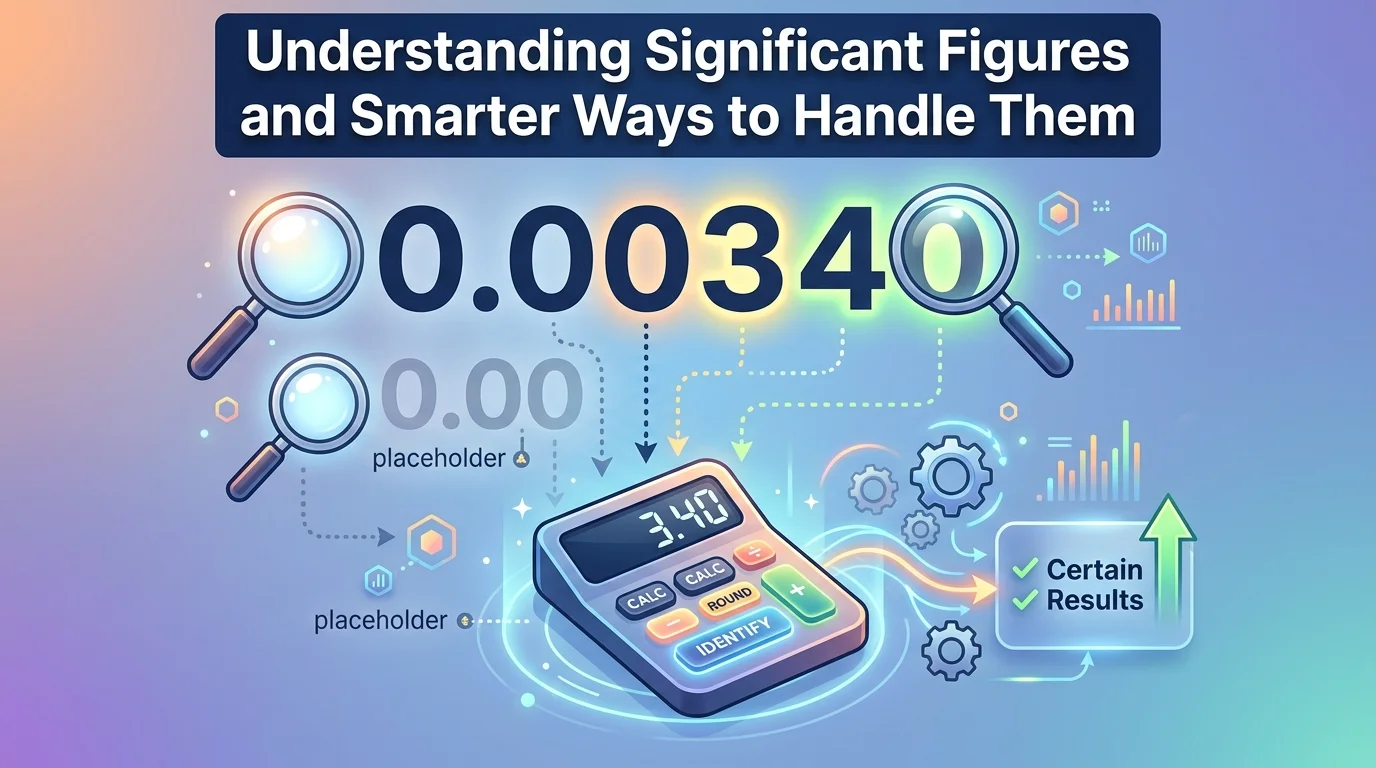
Understanding Significant Figures and Smarter Ways to Handle Them
Significant figures are one of those small details in mathematics and science that can quietly turn a sensible answer into a questionable one. The digits in a measurement do not all carry the same level of certainty. Some show what we know, while others may only be there because of the way a number is written.
This is where a sig fig calculator becomes useful. It can identify significant digits, round values correctly, and prepare numbers for calculations. It is especially handy when accuracy matters and manually tracking every zero starts to feel like a puzzle.
What Significant Figures Actually Tell You?
Significant figures are the digits in a measured or calculated value that communicate its precision. They include every certain digit and, depending on the measurement, one final estimated digit.
For example, 24.7 has three significant figures. If it is written as 24.70, it has four because the final zero shows a greater level of precision.
The two values represent the same numerical quantity, but they do not communicate the same precision. This is why significant figures matter in science, engineering, laboratory work, and technical calculations.
Why Precision Matters?
Imagine two thermometers. One reports 21°C, while another reports 21.36°C. The second reading gives more detail. Writing 21.36 does not magically make the thermometer more accurate, but it communicates that the measurement was recorded to a finer resolution.
Significant figures help prevent an answer from looking more precise than the information used to produce it.
The Rules Behind the Digits
Before using a calculator, it helps to understand the basic rules. They are not difficult once the common troublemakers—zeros—are out of the way.
Nonzero Digits Always Count
Every digit from 1 through 9 is significant.
- 7 has 1 significant figure.
- 52 has 2.
- 684.2 has 4.
Zeros Can Be Significant or Not
Zeros depend on their position.
Leading zeros are not significant. They only locate the decimal point.
- 0.0045 has 2 significant figures.
- 0.00072 has 2.
Zeros between nonzero digits are significant.
- 1002 has 4.
- 3.05 has 3.
Trailing zeros after a decimal point are significant.
- 4.50 has 3.
- 12.00 has 4.
Whole numbers ending in zeros can be ambiguous. Scientific notation removes that confusion: 1.5 × 10³ has 2 significant figures, while 1.500 × 10³ has 4.
How a Sig Fig Calculator Works?
At its core, the tool follows the same rules used manually. You enter a number, choose the required precision when needed, and the calculator examines the digits and their positions.
A typical process is:
- Read the number as entered.
- Identify the first meaningful digit.
- Check zeros based on their position.
- Count the significant digits.
- If rounding is requested, examine the next digit.
- Display the result in a suitable form.
For example, 0.006784 rounded to three significant figures becomes 0.00678. The first three meaningful digits are 6, 7, and 8, and the next digit is 4, so the last retained digit stays unchanged.
Rounding Without Losing Meaning
Rounding is not simply chopping off digits. The next digit determines what happens to the last digit you keep.
Suppose 58.367 needs four significant figures. The first four digits are 5, 8, 3, and 6. The next digit is 7, so the 6 becomes 7. The result is 58.37.
A useful habit is to avoid rounding too early during a multi-step calculation. Keep extra digits while working and round the final result according to the required rule. Early rounding can affect later calculations.
Significant Figures in Calculations
The rules change depending on the operation, which is one reason this topic can be confusing.
Multiplication and Division
For multiplication and division, the final answer generally has the same number of significant figures as the value with the fewest significant figures.
For example:
2.5 × 3.42 = 8.55
The first value has 2 significant figures, so the reported answer is 8.6.
Addition and Subtraction
For addition and subtraction, decimal places matter instead of the total number of significant figures.
Consider:
12.11 + 3.2 = 15.31
The second number reaches only one decimal place, so the result should be 15.3.
A quick reminder:
- Multiplication and division → fewest significant figures.
- Addition and subtraction → fewest decimal places.
What Can You Use It For?
A good calculator can do more than count digits. Depending on the tool, it may help with:
- Counting significant figures in measurements.
- Rounding values to a chosen precision.
- Checking manually calculated answers.
- Converting results into scientific notation.
- Applying precision rules to multiplication and division.
- Applying decimal-place rules to addition and subtraction.
- Preparing laboratory results for reports.
- Reducing accidental over-precision.
Students commonly use these tools for chemistry, physics, biology, engineering, and mathematics. They are also useful whenever a calculation contains many decimal places and manually tracking each digit becomes tedious.
A Few Examples
Here are some quick examples:
| Number | Significant figures |
| 45.8 | 3 |
| 0.0072 | 2 |
| 6.030 | 4 |
| 7005 | 4 |
| 0.0500 | 3 |
| 9.00 | 3 |
Notice how the zeros behave differently depending on where they appear.
For another example, 0.0009060 has four significant figures. The leading zeros do not count, but the zero between 9 and 6 does, and the final zero after the decimal also counts.
Keeping Results Accurate
One major benefit of significant figures is preventing false precision. A calculator may produce ten or fifteen digits after the decimal point, but that does not mean the original measurements justify all of them.
Suppose you measure a length as 5.2 cm and another as 2.1 cm. Multiplying them gives 10.92 cm² on a calculator. Reporting all four significant figures suggests more precision than the measurements provide.
A more appropriate result is 11 cm², using two significant figures.
The tool is not deciding how accurate your measuring equipment is. It is helping you express the result consistently with the precision of the input.
The Role of Exact Values
Not every number in a calculation comes from measurement. Some numbers are exact.
If a teacher says there are exactly 12 eggs in a dozen, the 12 is an exact counted value. Defined relationships can also be exact. Such numbers do not limit significant figures in the same way measured quantities do.
This distinction matters because significant-figure rules are mainly concerned with measured quantities and their uncertainty.
Why Does Scientific Notation Helps?
Scientific notation is useful when significant figures could otherwise be unclear.
For example, 0.000450 has three significant figures. In scientific notation it becomes:
4.50 × 10⁻⁴
The three significant figures are now obvious.
Scientific notation also makes extremely large or tiny values easier to read, which is why it appears frequently in science and engineering.
Common Mistakes to Watch For
Even simple rules can cause repeated mistakes.
- Counting Every Zero: A zero at the beginning of a decimal number usually does not count. In 0.0038, the first three zeros are placeholders.
- Dropping Meaningful Zeros: In 7.20, the final zero communicates precision. Changing it to 7.2 changes the stated precision.
- Rounding Too Soon: During a long calculation, rounding every intermediate result can create avoidable differences. Keep extra digits until the final step unless instructions say otherwise.
- Assuming More Digits Mean More Accuracy: A longer answer is not automatically a better answer. If the measurements are limited, the final result should reflect those limits.
Choosing a Reliable Tool
When using an online calculator, do not judge it only by how quickly it produces a number. A useful tool should make the result understandable.
Look for:
- Clear input and output.
- Support for decimal and scientific notation.
- A visible significant-figure count.
- Straightforward rounding options.
- Correct handling of zeros.
- Explanations or examples when available.
- A simple interface without unnecessary distractions.
For students, an explanation can be as valuable as the final number because it makes mistakes easier to spot.
Final Thoughts
Significant figures are not simply about counting digits or making numbers look neat. They help communicate how precise a measurement or calculation really is. Once the basic rules become familiar, things like leading zeros, trailing zeros, rounding, and decimal places become much easier to handle.
A sig fig calculator can take care of the repetitive part, especially when several numbers or calculations are involved. It can quickly count significant figures, round results, and provide a useful check when working through scientific or mathematical problems. Still, knowing the reasoning behind the result is important because a calculator can follow a rule, but it cannot always decide whether the original measurement was recorded appropriately.
The best approach is to understand the rules first and use the tool to save time and reduce simple mistakes. With that combination, significant figures stop being one of those frustrating little details and become a practical way to present numerical results clearly, consistently, and with the right level of precision.