Riftbound TCG Guide – How The Game Works From Start To Finish?
Trading card games can be difficult to understand when you first encounter them, especially when they introduce their own terminology, resources, card types, and win conditions. Riftbound takes a different approach by combining the characters and world of League of Legends with a physical strategy card game built around positioning, combat, resources, and control of special locations called Battlefields.
Instead of simply reducing an opponent’s health to zero, players compete to gain points by taking control of Battlefields. Champions, units, spells, Gear, Legends, and Runes all contribute to this objective. The result is a game where choosing where to move can be just as important as choosing which card to play.
What Is Riftbound?
Riftbound: League of Legends Trading Card Game is a physical collectible card game created by Riot Games. It uses characters and themes from the League of Legends universe while giving them new roles within a tabletop strategy system.
The game supports two to four players, allowing both traditional one-on-one matches and multiplayer formats. Riot describes its central idea simply: players choose a champion, build an army, use spells, and compete for control of Battlefields.
The English release launched on October 31, 2025, with Origins serving as the first set. Since then, Riot has continued expanding the game through additional releases and organized play.
For League of Legends fans, the recognizable champions provide an obvious connection. For experienced TCG players, however, the game’s real appeal comes from its unusual battlefield-focused structure.
The Main Goal Of The Game
The objective is to reach the required number of points before your opponents.
In a standard individual game, the target is 8 points. Points mainly come from controlling Battlefields, and there are two important ways that control can produce progress:
- Conquering a Battlefield: Defeat the opposing forces and establish control.
- Holding a Battlefield: Maintain a presence there and score from continued control at the appropriate point in the turn.
This creates an important strategic difference from many traditional card games. You are not simply trying to destroy everything your opponent plays. Sometimes the correct move is to contest a location, while at other times it is better to protect a Battlefield you already control.
Riot’s introductory rules describe the central loop as moving Champions and Units toward Battlefields, fighting for control, and earning points from successful control.
Understanding The Battlefield System
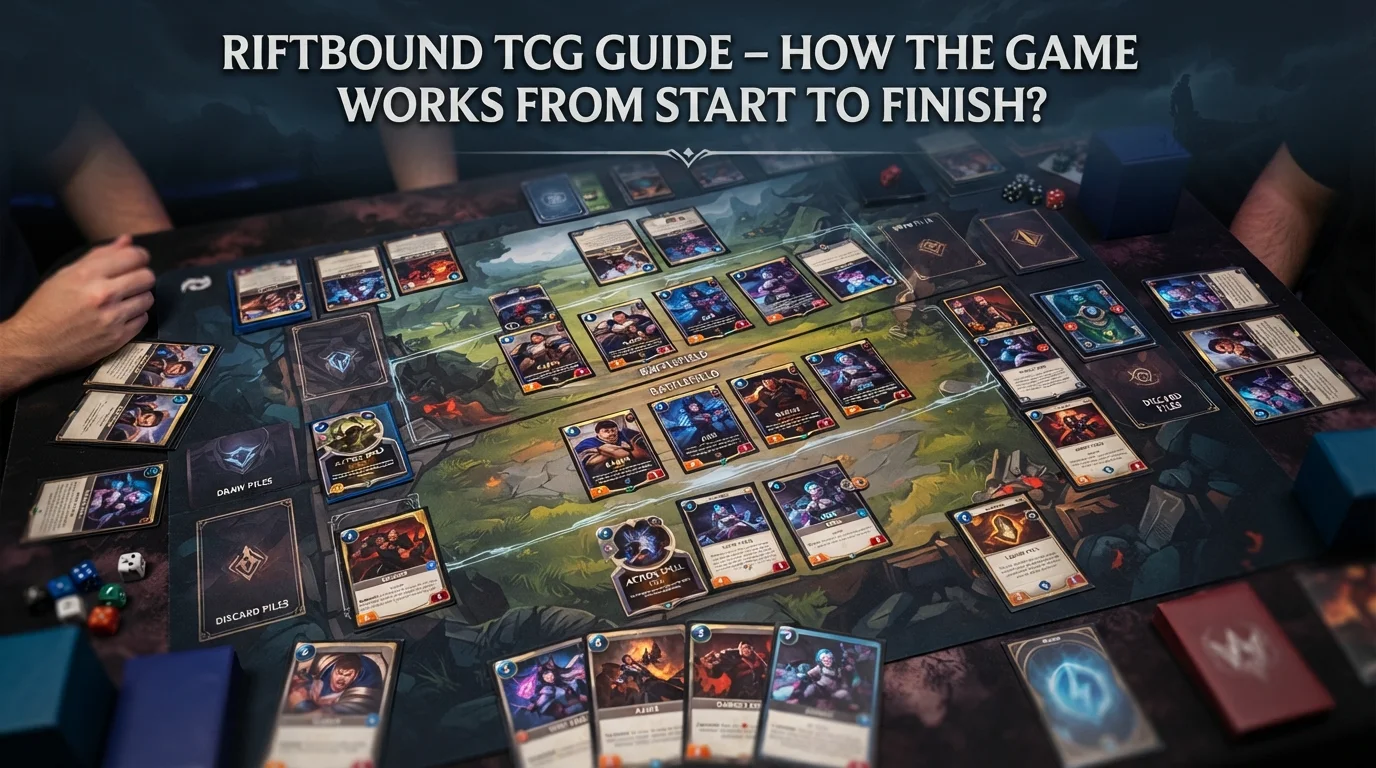
Battlefields are the locations where much of the game’s action takes place. They give the match its positional character because players have to decide where their Units should be deployed and when they should move.
A Battlefield can be empty, occupied by one player, or contested by opposing forces. Entering an occupied location can trigger a confrontation known as a Showdown, turning movement into a potential battle.
This creates several decisions during a match:
- Which Battlefield should receive your Units?
- Should you defend a location or attack another one?
- Is it worth committing several Units to a single area?
- Can you force your opponent to spend resources defending?
- Can you create a path toward the next scoring opportunity?
Because positioning matters so much, a powerful card does not automatically create a winning position. A well-timed movement or carefully planned attack can sometimes be more valuable than simply playing the biggest Unit available.
Legends And Champions
One of the first major decisions when building a deck is selecting a Legend. The Legend acts as the foundation of the deck and determines important construction restrictions, including the Domains available to you.
Champions are represented as Units, but they are more than ordinary characters. Your selected Champion can influence the strategy of the entire deck and gives your list a recognizable identity.
The distinction is useful for new players:
- Legend: The central deck-building identity and commander-like foundation.
- Champion: A powerful character Unit associated with that Legend.
- Other Units: The supporting army that occupies Battlefields and participates in combat.
This system allows two decks using characters from the same League of Legends universe to play very differently. One may concentrate on aggressive movement, while another can focus on controlling the board and gaining value over several turns.
The Main Card Types
Learning the major card categories makes the game much easier to understand. Riot identifies several core types, including Units, Spells, Gear, Champions, Legends, and Battlefields.
Units
Units make up the main forces on the board and are responsible for much of the action during a match. They can be deployed from your Base to Battlefields and used to challenge locations controlled by your opponent. Different Units have different abilities, costs, and levels of Might, so they can serve different purposes within a deck.
Some may be useful for early pressure, while others are designed to provide stronger support later in the game. Their Might determines their combat strength and becomes especially important when Units clash during a Showdown.
Champions
Champions are special Units based on familiar League of Legends characters and are connected to the Legend chosen for your deck. They can have stronger abilities or unique effects that help define how your deck operates.
Because Champions can influence the way you approach combat, movement, and resource management, choosing the right one is an important part of building a deck. Their abilities can also create opportunities that ordinary Units may not provide.
Spells
Spells are cards designed to create immediate effects or respond to situations as they develop on the board. Depending on the card, a Spell can strengthen one of your Units, disrupt an opponent’s plans, remove a threat, or provide another tactical advantage.
Some Spells are most useful during combat, while others can help you prepare for a future move. Learning when to save a Spell and when to use it immediately can make a significant difference during a close match.
Gear
Gear cards provide effects that can continue influencing the game after they are played. Rather than producing only a single instant effect, Gear can support a Unit or improve your overall position over several turns.
This makes Gear useful for strategies that depend on building an advantage gradually. Players need to consider both the immediate cost of playing Gear and the longer-term value it can provide if the equipped Unit remains active.
Legends
Legends provide the foundation for deck construction and help determine the overall identity of a deck. Your chosen Legend affects which cards and Domains you can use, meaning the decision influences many other choices during deck building.
Legends can also encourage particular playstyles by working naturally with certain Champions, Units, and effects. As a result, selecting a Legend is not simply a character choice; it helps establish the strategy around which the rest of the deck is built.
Battlefields
Battlefields are the locations where players compete for control, making them a central part of the game’s board strategy. They are separate from the Main Deck and are selected as part of deck construction.
Each Battlefield can introduce different conditions or opportunities, so players should choose locations that work well with their preferred strategy. During a match, deciding when to move toward a Battlefield, defend it, or challenge an opponent there can be just as important as choosing which card to play.
How Runes Work?
Resources are handled through a separate Rune Deck, which is one of the game’s most distinctive systems.
Rather than using lands or a traditional energy pile, players use Runes to pay for cards. Riot’s introductory material explains that players gain two Runes during each turn and can use them in different ways.
A Rune can generally be used as a temporary resource by exhausting it. Some stronger effects can instead require Runes to be recycled, sending them back to the Rune Deck rather than merely exhausting them.
This creates an interesting resource decision. Using a Rune now may let you play an important card immediately, but recycling resources for a powerful effect can influence how much you can afford later.
What Happens During A Turn?
A turn consists of several stages designed to refresh resources, award points, draw cards, and then give the active player opportunities to act.
The broad flow includes:
- Awaken: Previously exhausted cards are readied.
- Beginning: Scoring and resource-related steps take place.
- Channel: New Runes are added to your available resources.
- Draw: A card is drawn from the main deck.
- Action: The player performs the main actions of the turn.
The Action portion is where most strategic decisions happen. Players can deploy Units, use abilities, play Spells, position their forces, and begin confrontations.
Going second can also provide an additional resource during the opening turn, helping offset the advantage of acting first.
Movement And Showdowns
Movement is one of the mechanics that gives the game its identity.
Units can move between your Base and Battlefields under the appropriate conditions. When forces enter a location occupied by an opponent, the situation can become a Showdown.
During a Showdown, players can respond with appropriate effects before combat takes place. This means the battle is not always decided the moment Units enter the same location.
Players must consider whether the opponent has:
- A defensive Spell
- A combat trick
- A Unit ability
- A way to remove or reposition your Unit
- Enough resources to change the outcome
After the response window closes, combat determines which Units survive and whether control of the Battlefield changes.
How Combat Works?
Combat revolves around Might.
Attacking Units combine their combat strength, while defending Units contribute their own Might. Damage is assigned according to the combat rules, and Units that receive enough damage can be destroyed.
An important detail is that surviving Units do not simply carry their previous combat damage forever. After the relevant combat concludes, surviving Units recover, allowing the same forces to participate in later battles.
The basic combat process can therefore be viewed as:
- Units enter a contested Battlefield.
- Players have opportunities to use relevant effects.
- Combat values are calculated.
- Damage is assigned.
- Destroyed Units leave play.
- The surviving side may establish or retain control.
This makes combat about more than having the highest number. Timing, card effects, positioning, and resource management can all change the result.
Building A Deck
Deck construction is another important part of the experience. A standard deck includes a 40-card Main Deck, a separate 12-card Rune Deck, and three distinct Battlefields. Deck-building restrictions are tied to the chosen Legend and its Domains.
A practical deck-building process looks like this:
Choose Your Legend:-
Start with the Champion Legend that matches the type of strategy you want to explore.
Select a Champion:-
Choose the Champion Unit that works with your Legend and fits the deck’s plan.
Build Around a Strategy:-
Your cards should support a clear approach instead of functioning as unrelated individual pieces.
Possible approaches include:
- Fast pressure
- Board control
- Midrange development
- Resource-based strategies
- Combat-focused decks
- Battlefield-focused positioning
Balance the Curve:-
A deck containing only expensive cards may struggle to establish a board early. A list filled exclusively with cheap cards can have difficulty closing games later.
Select Your Battlefields:-
Your Battlefield choices should complement the way your deck wants to play. A strategy that depends heavily on aggressive movement may prefer different locations from a deck designed to defend and accumulate points.
Collecting And Card Rarities
The game also has a substantial collectible side. Cards come in different rarities, and sets can include special treatments such as alternate artwork and harder-to-find versions.
Riot’s preview information for Origins described rarities ranging from Common through Epic, along with Overnumbered cards and alternate-art treatments.
For collectors, this means opening a booster is not only about finding playable cards. The appeal can also come from artwork, rarity, special versions, and completing a particular collection.
The original Origins booster configuration included Common, Uncommon, Rare-or-better, Foil, and Token/Rune slots.
Competitive Play And Expanding Sets
The game has developed beyond casual kitchen-table matches. Riot has established organized events and a competitive tournament structure, while its 2026 roadmap includes Regional Qualifiers and additional set releases.
That expansion matters because new sets introduce additional cards and strategies. As the card pool grows, players have more options for deck construction, while competitive players must continually adjust their lists and understand new interactions.
For newcomers, however, there is no need to start with competitive-level deck building. Learning the basic rules, playing a few games, and understanding how resources and Battlefields interact is a much more useful first step.
Why The Game Feels Different?
The strongest defining feature of Riftbound is the way it combines card-game decisions with board positioning.
Traditional TCG experience can certainly help, but knowing when to move, when to defend, and when to challenge a Battlefield adds another layer of decision-making.
A player may have an excellent hand but still lose control of the match by committing Units to the wrong location. Conversely, a player with fewer flashy cards can create a strong position by managing resources carefully and forcing the opponent to respond.
That combination makes every turn involve several connected questions: What can I play? Where should I place it? What does my opponent threaten? And how does this move affect the next scoring opportunity?
Final Thoughts
Riftbound brings the League of Legends universe into a physical trading card game where movement, combat, resources, and Battlefield control work together. Its separate Rune system gives players another resource layer, while Legends and Domains provide a framework for building focused decks.
For beginners, the best place to start is with the basic turn structure, card types, Rune system, and scoring rules. Once those foundations become familiar, the deeper strategy comes from understanding positioning, timing, combat tricks, and deck construction.
Whether someone approaches the game as a League of Legends fan, a competitive TCG player, or a collector interested in its cards and artwork, the core experience remains centered on one thing: making better decisions with limited resources while fighting for control of the board.